Native Hedging vs. Fencing: Costs, Wildlife Value, and How to Plant
As an Amazon Associate I earn from qualifying purchases and sometimes recommend products from other sellers at no extra cost you. For more details see my disclosure policy and privacy policy.
Daya Tree • Rewilding & Wildlife-Friendly Gardening • By Nikki Piggott
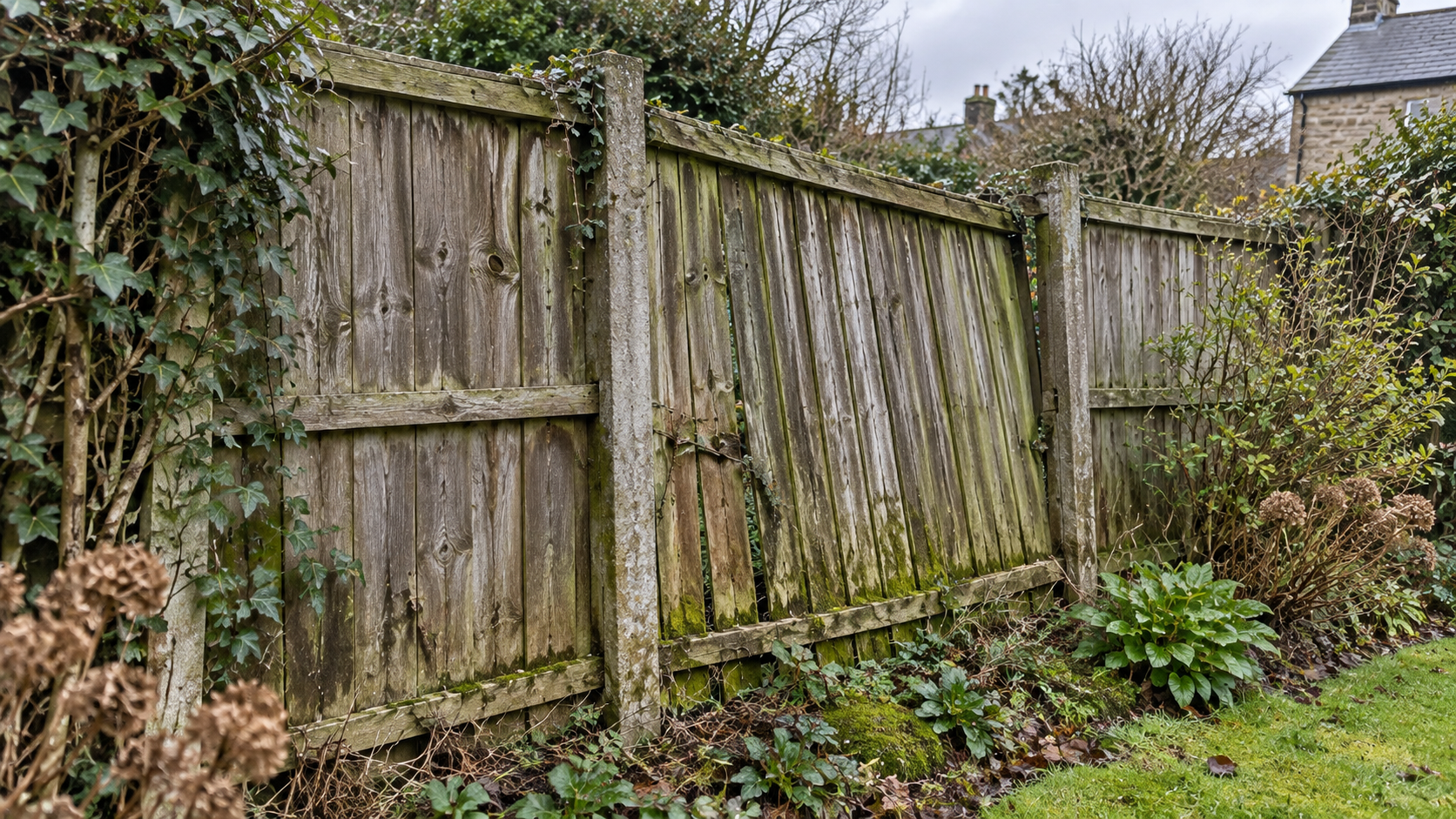
When we moved into our home the back garden was wrapped in close-board fencing. Panel by panel, it was already starting to warp. Our neighbours’ cats treated it as a motorway. And not a single bird nested in it.
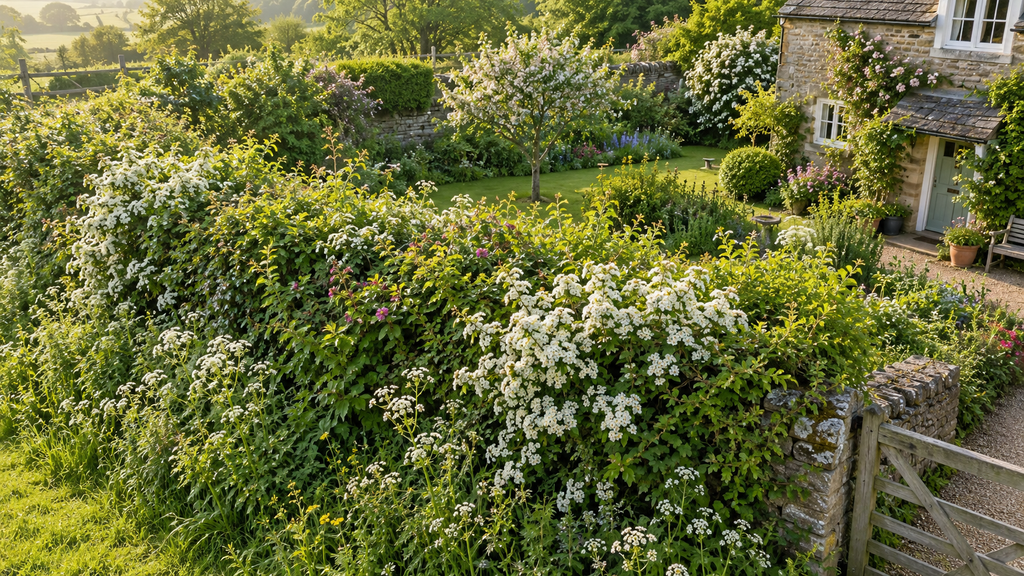
Three years later, we replaced the longest run of fence with a mixed native hedge. It cost roughly the same as a fresh set of fence panels would have, and the difference to our garden’s wildlife has been extraordinary. Last spring I counted blackbirds, wrens, dunnocks, and a pair of long-tailed tits all using it within a single afternoon.
This post is for anyone weighing up the same decision: fencing vs. native hedging. I’ll walk through the honest costs of each, the wildlife case for hedges, which plants to choose for a UK garden, and how to actually get one in the ground this autumn or winter — when planting is cheapest and easiest.
Free download
Get the Non‑Toxic Home Audit Checklist
A room‑by‑room checklist to help you spot what’s worth swapping in your home — and what’s not worth worrying about. Join the fortnightly newsletter and it’s yours.
No spam, unsubscribe any time.
Quick summary: Native hedging typically costs less per metre than quality fencing over a 15-year horizon, provides dramatically better wildlife habitat, and is effectively permanent once established. The main trade-off is time: a hedge takes 3–5 years to reach full height and density.
The Honest Cost Comparison
Let’s start with the numbers, because “fencing is cheaper” is one of the most persistent myths in garden planning. Here’s what the real figures look like.
What fencing actually costs
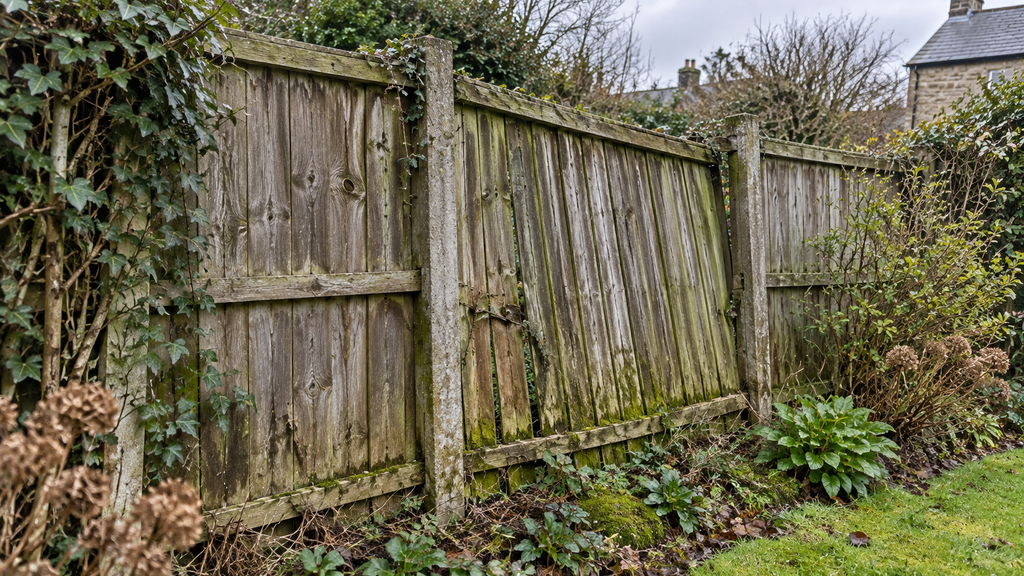
Good close-board fencing — the solid, vertical-slat type standard in UK gardens — runs from about £90 to £130 per linear metre installed, including posts, gravel boards, and labour. Featherboard panels at 1.5m height come in slightly cheaper at £60–£90/m.
The problem with those numbers isn’t the upfront cost — it’s the ongoing cost. Timber fencing in the UK needs staining or treating every 2–3 years to stay weatherproof. Panels get blown down in storms and need replacing. Posts rot at the base. A realistic lifespan for a well-maintained close-board fence is 15 years; many don’t make it to ten. Over that period, the true cost per metre is considerably higher than the installation quote suggests.
What native hedging actually costs
Bare-root native hedging plants — bought in their dormant season between November and March — cost between £3 and £8 per plant, depending on species and supplier. For a mixed native hedge at a recommended density of 3–5 plants per metre, you’re looking at roughly £15–£40 per linear metre in plant material alone.
Add in stakes, rabbit guards if deer or rabbits are a concern in your area, mulch, and a couple of hours of your time to plant them, and a realistic total comes to around £40–£80 per metre — installed by you, at weekends, for free. If you pay a landscaper, add labour on top.
After year three or four, a well-established hedge requires only one or two cuts per year and nothing else. No staining, no replacing panels, no rotting posts.
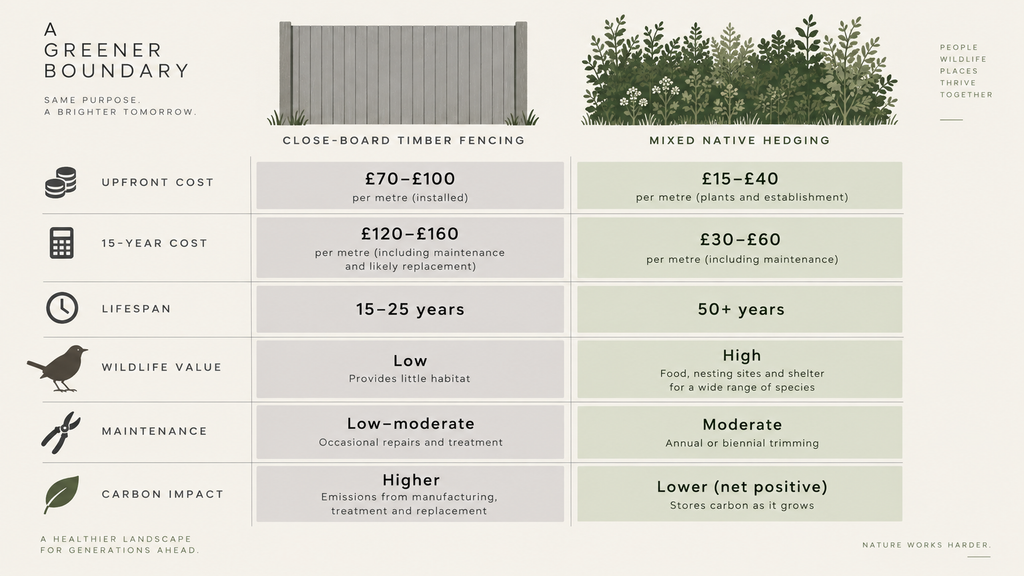
Cost comparison per linear metre (approximate UK 2026 figures):
| Option | Install Cost | Annual Upkeep | Lifespan |
|---|---|---|---|
| Close-board fencing (1.8m) | £90–£130/m | £5–£15/m (stain/repair) | 10–15 years |
| Featherboard fencing (1.5m) | £60–£90/m | £5–£10/m | 10–20 years |
| Mixed native hedging (bare-root) | £3–£8/plant | Low once established | Indefinite |
| Instant hedging (pot-grown) | £20–£60/m | Trimming only | Indefinite |
| Post and rail + native hedge | £20–£40/m | Very low | Indefinite |
The RHS recommends bare-root planting between November and March as the most cost-effective way to establish native hedging in UK gardens. This is also when plants are least stressed and establishment rates are highest.
The Wildlife Case for Native Hedging
Fencing is a dead end for wildlife — literally. A 1.8m close-board fence provides almost nothing: no food, no nesting sites, no safe corridors for mammals, and it actively blocks movement between gardens.
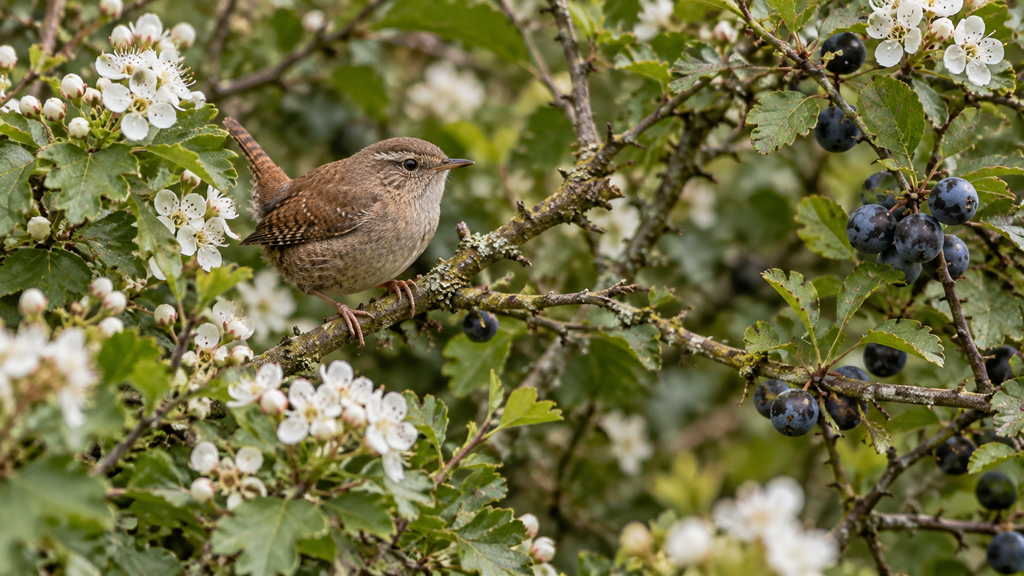
A native hedge is the opposite. It’s a three-dimensional habitat: the base provides cover for hedgehogs and small mammals; the lower branches suit nesting wrens and dunnocks; the upper canopy works for blackbirds and song thrushes. Flowers feed bees and hoverflies in spring. Berries and hips feed birds and small mammals through autumn and winter. The decaying leaf litter at the base feeds beetles, which in turn feed shrews and slow worms.
Why native species matter
Not all hedging is equal. Leylandii, the most commonly planted garden hedge in the UK, supports fewer than 10 insect species. A mature hawthorn, by contrast, supports over 300. This isn’t a small difference — it’s the difference between a hedge that functions as a wall and one that functions as an ecosystem.
The key principle is this: the insects that UK wildlife depends on evolved alongside UK plants over thousands of years. Native species have co-evolved relationships with native insects that introduced ornamentals simply cannot replicate. A box hedge looks tidy, but a mixed hawthorn, blackthorn, and hazel hedge feeds an entire food chain.
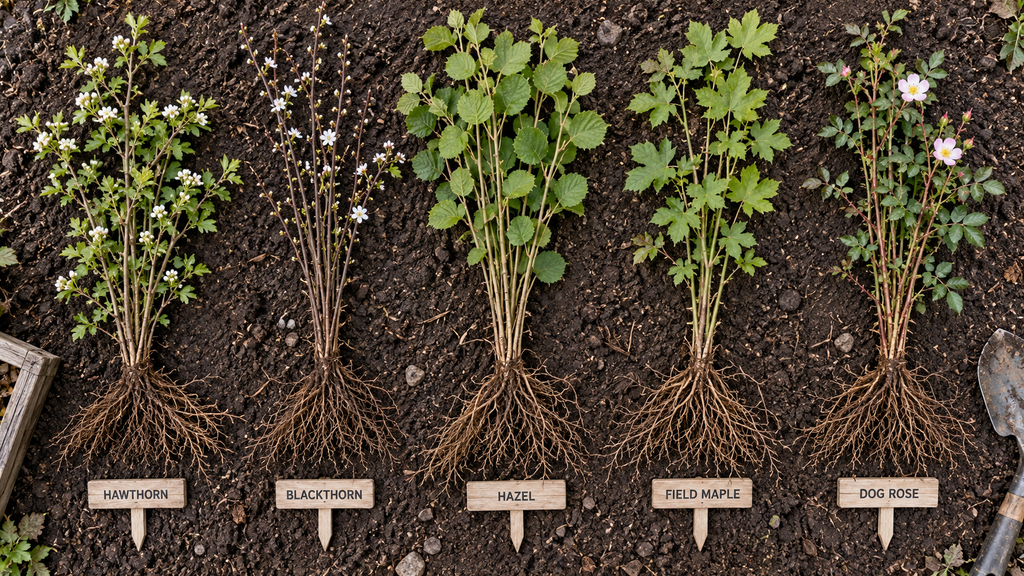
Wildlife value by species
Native hedging plants and their wildlife value:
| Hedging Plant | Birds | Insects | Mammals | Winter Food |
|---|---|---|---|---|
| Hawthorn | ★★★★★ | ★★★★★ | ★★★★★ | Yes (haws) |
| Blackthorn | ★★★★★ | ★★★★ | ★★★★★ | Yes (sloes) |
| Hazel | ★★★★ | ★★★★ | ★★★★★ | Nuts |
| Field maple | ★★★★ | ★★★★★ | ★★★ | No |
| Holly | ★★★★★ | ★★★ | ★★★ | Yes (berries) |
| Dog rose | ★★★★ | ★★★★★ | ★★★★ | Yes (hips) |
Hawthorn is the single most wildlife-valuable hedging plant in the UK. It flowers early, feeds pollinators prolifically, and produces haws — the red berries — that sustain fieldfares and redwings through winter. If you plant nothing else, plant hawthorn.
The hedgehog highway benefit
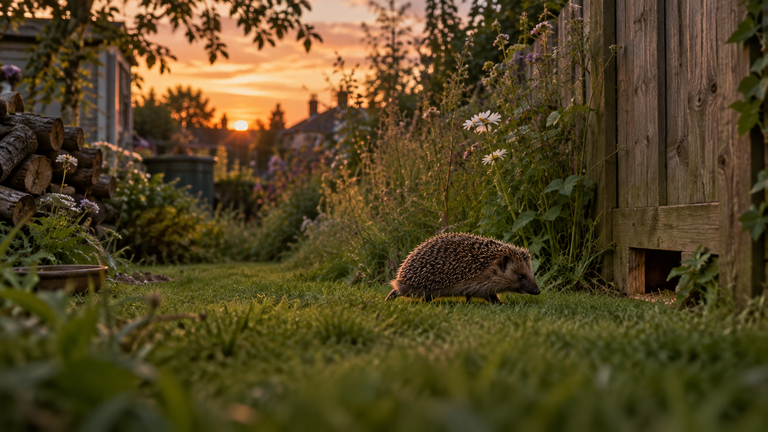
One of the most practical wildlife benefits of replacing solid fencing with hedging is that it immediately creates gaps for hedgehog movement. UK hedgehog populations have declined dramatically in recent decades, partly because gardens have become increasingly fenced-off fortresses that animals cannot move through. A hedge, by contrast, is permeable by design — hedgehogs, frogs, toads, and slow worms can all pass through at the base.
If you’re keeping some fencing, make sure to cut a 13cm × 13cm hedgehog highway at the base of each panel where it adjoins a neighbour’s garden. It takes five minutes with a jigsaw and genuinely makes a difference.
Which Native Plants to Choose
The best native hedging mixes for UK gardens depend partly on your region and soil, but these five species form the backbone of almost any wildlife hedge in England, Scotland, and Wales.
Hawthorn (Crataegus monogyna)
Non-negotiable in any mixed native hedge. Fast-growing, thorny enough to deter people and predators, spectacular in blossom in May, and laden with haws in autumn. Tolerates almost any soil and aspect. Makes up about 50–60% of most native hedging mixes.
Blackthorn (Prunus spinosa)
One of the earliest flowering native shrubs, providing crucial early pollen and nectar when little else is available. Produces sloes in autumn — useful for sloe gin as well as wildlife. Very thorny, which creates excellent nesting security. Use as 15–20% of your mix.
Hazel (Corylus avellana)
Produces catkins in late winter that feed early bumblebees, and hazelnuts in autumn eaten by dormice, wood mice, and nuthatches. Grows vigorously and can be coppiced if the hedge gets too wide. Aim for around 20% of your mix.
Field maple (Acer campestre)
The only maple native to the UK. Produces winged seeds that feed finches, and its flowers are highly attractive to aphids — which might sound like a disadvantage, but aphids are a critical food source for blue tits and great tits feeding chicks in spring. Good autumn colour too.
Dog rose (Rosa canina)
Add a few dog roses into your hedge for spectacular June flowers — some of the best for solitary bees — and large red hips in autumn that are among the most nutritious winter food sources for birds. Keep it to around 10% of your mix as it can be vigorous.
Avoid cherry laurel, privet, and leylandii. All three are widely sold as hedge plants, but their wildlife value is minimal, and cherry laurel is invasive in UK woodland. Stick to native species wherever possible.
How to Plant a Native Hedge: Step by Step
The best time to plant bare-root native hedging in the UK is between November and March, when plants are dormant. This is also when bare-root stock is cheapest — often a quarter of the price of pot-grown plants. I’ll describe the process I’ve used.
Step 1: Order your plants
Order bare-root hedging from a reputable UK native plant nursery. Thompson & Morgan and Suttons Seeds are convenient for online ordering, though specialist native plant nurseries often have a wider range at better prices. Order by October for November delivery if possible, as stock sells out.
Calculate your plants at 3–5 per metre for a single-row hedge, or 5–7 per metre if you want a double staggered row, which is wider but denser within five years. A double-staggered row is worth it for a boundary hedge you want to be stock-proof or genuinely private.
Step 2: Prepare the ground
Mark out your hedge line with string. A week or two before planting, clear a 60cm-wide strip of turf and weeds along the line. Grass competition is one of the main causes of hedge failure in the first two years. You can rotavate, use a spade to remove turf, or apply a thick layer of cardboard mulch covered with woodchip to smother existing vegetation.
If your soil is very heavy clay, work in some grit and organic matter. Most native species are tolerant of poor soil, but very waterlogged conditions will set them back.
Step 3: Plant
Bare-root plants need to go in promptly after delivery — don’t let the roots dry out. If you can’t plant immediately, heel them in temporarily in a sheltered spot.
Dig a hole or trench wide and deep enough for the roots to spread naturally. Set each plant at the same depth as its nursery soil mark (the dark stain on the stem). Firm the soil back around the roots well — air pockets cause root desiccation — and water in even in winter.
For a 10-metre hedge run, allow half a day of work if the ground is prepared.
Step 4: Mulch and protect
Apply a 10cm layer of woodchip mulch in a 60cm circle around each plant, keeping it away from the stem. This suppresses weeds and retains moisture through the first summer, which is the most critical period. Reapply each spring for the first two years.
In areas with rabbits or deer, fit spiral tree guards or rabbit netting around individual plants. Rabbits will bark young hawthorn and kill it quickly if left unprotected.
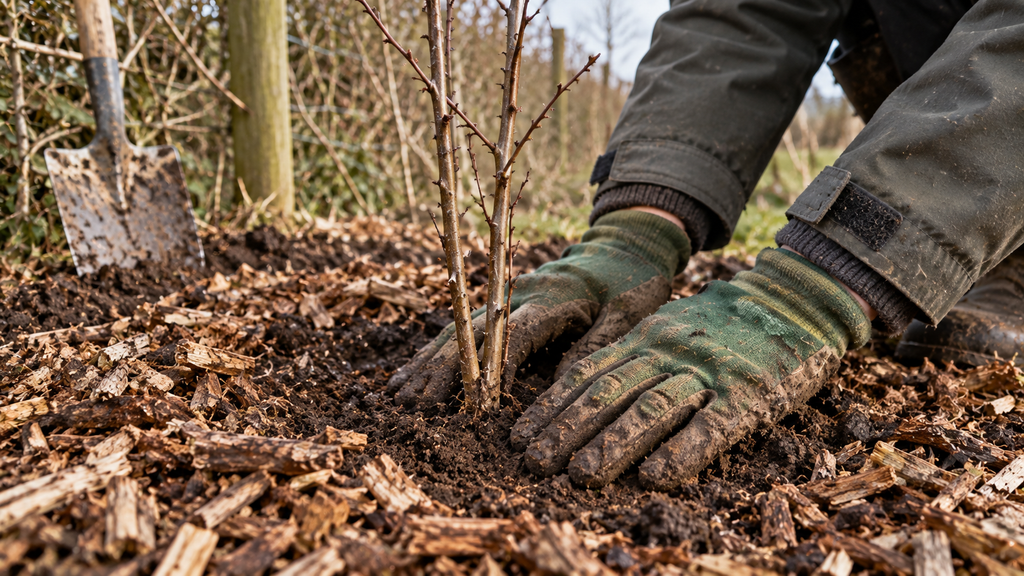
Step 5: First-year care
In the first spring after planting, cut all stems back by one-third. This looks brutal but encourages bushy growth from the base, which is what creates a dense, stock-proof hedge over time. Skip this step and you’ll end up with a leggy, top-heavy hedge with bare legs.
In the first summer, water during any dry spells longer than two weeks. After year two, a well-mulched hedge of native species should be self-sufficient.
Year 1: Plant and cut back hard. Year 2: Let grow, trim lightly in August. Year 3 onwards: Cut once or twice a year — late summer after nesting season ends, and again in late winter if needed. Never cut between March and August to protect nesting birds.
When Fencing Still Makes Sense
I’m not anti-fence. There are situations where fencing is the right choice, and it’s worth being honest about them.
Very small gardens where a 60cm-wide hedge run would take up a disproportionate amount of growing space.
Rental properties where you need a boundary structure that goes in quickly and can be taken down or left behind.
Immediate privacy needs. A 1.8m fence provides privacy on day one. A hedge of equivalent density takes 3–5 years.
Where hedgehog access is not possible at the boundary, such as adjacent to a busy road. A solid fence can actually protect garden wildlife in these cases.
For many gardens, the best solution is a combination: keep existing fencing where it works, and add native hedging inside or alongside it where space allows. Even a two-metre-wide strip of native planting along one boundary creates meaningful habitat.
The Bottom Line
Fencing is a short-term solution with a long-term cost. Native hedging is the opposite: it takes longer to establish, but once it does, it’s effectively permanent, self-sustaining, and ecologically productive in a way that no fence can match.
The case for native hedging in a UK garden isn’t just environmental. It’s also financial over any horizon beyond 15 years, and deeply satisfying in a way that a pressure-treated fence panel never will be. The first time a wren nests in your newly established hedge — and it will nest, if the hedge is there — the decision feels very clearly made.
If you’re ready to start, the cheapest and best time to plant is this coming winter. Order bare-root stock in October, prepare the ground in November, and plant from late November onwards. In five years, you’ll wonder why you waited.
The Complete Guide to Rewilding Your UK Garden (2026 / Wildlife Pond in a Small Garden: How to Do It Affordably / UK Native Plants for Pollinators: A Species-by-Species Guide