Replacing Your Lawn: Clover Mixes, Wildflower Patches, and What Actually Works in UK Soil
As an Amazon Associate I earn from qualifying purchases and sometimes recommend products from other sellers at no extra cost you. For more details see my disclosure policy and privacy policy.
Lawns are having a bit of an identity crisis. For decades, the ideal British garden meant a flat, striped, weed-free rectangle of grass — the kind that requires a weekly mow, a seasonal feed, and a grudging hosepipe ban apology every August. But that picture is changing fast. More and more UK gardeners are asking: is there something better I could be doing with this space?
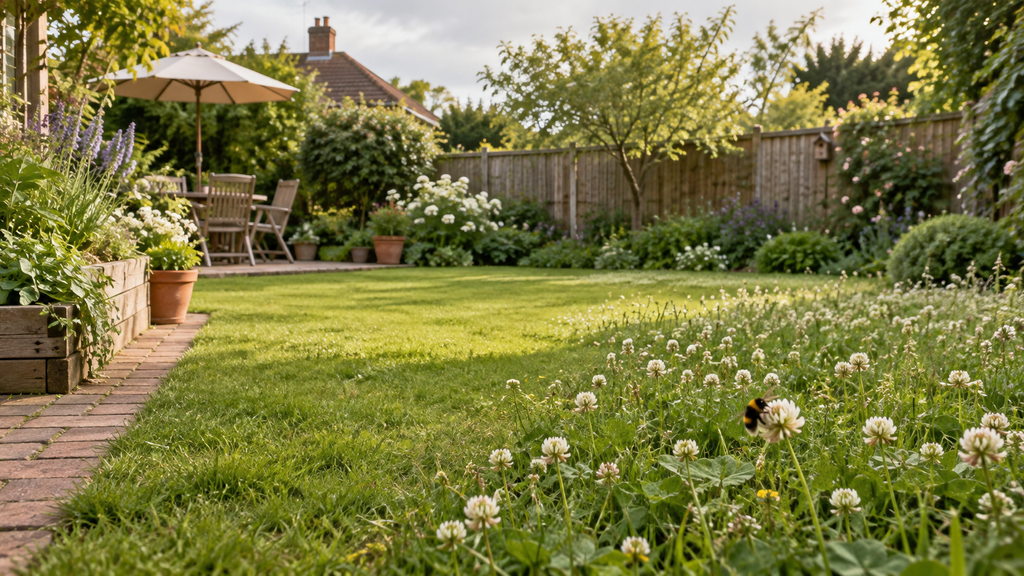
The short answer is yes — and it doesn’t have to mean sacrifice. Replacing all or part of your lawn with clover, wildflowers, native ground cover, or a mix of all three can reduce your maintenance time, cut your water use, support pollinators, and honestly look more interesting than a standard grass patch from June through to October.
Here’s what I’ve found actually works in UK conditions — including what doesn’t, which no one tells you upfront.
Why Bother Replacing Your Lawn at All?
Standard lawns are, ecologically speaking, a bit of a desert. A heavily managed grass monoculture offers very little to insects, birds, or soil life. It needs regular cutting (which produces emissions if you’re using a petrol mower), it tends to compact over time, and in a dry summer it browns out and looks miserable.
Free download
Get the Non‑Toxic Home Audit Checklist
A room‑by‑room checklist to help you spot what’s worth swapping in your home — and what’s not worth worrying about. Join the fortnightly newsletter and it’s yours.
No spam, unsubscribe any time.
The Royal Horticultural Society has named rewilding and wildlife-friendly gardening as one of the headline trends for 2026, and campaigns like No Mow May have helped shift public thinking about what a ‘good’ garden actually looks like. But you don’t have to go fully wild to make a difference. Even replacing 20% of your lawn area with clover mix makes a measurable difference to local bee populations.
From a practical standpoint, the financial case is also real. Less mowing means less fuel, less equipment maintenance, and less time. A well-established clover or wildflower patch needs cutting only once or twice a year, compared to weekly or fortnightly for grass.
Option 1: Clover Mixes — The Low-Effort Starting Point
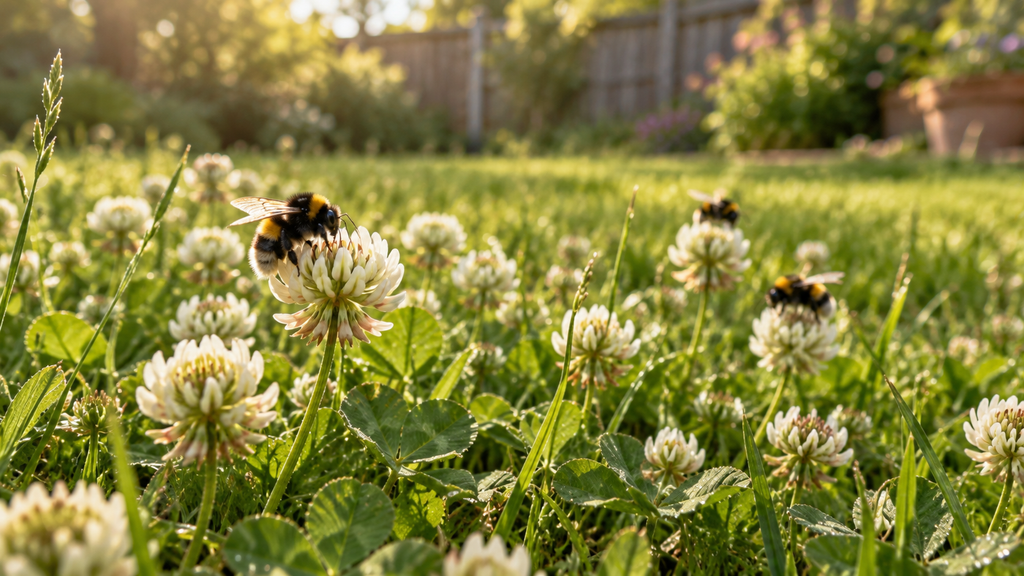
If you want to make one change that is genuinely low-effort and delivers results quickly, overseeding your existing lawn with white clover (Trifolium repens) is it.
Why clover works so well in UK gardens
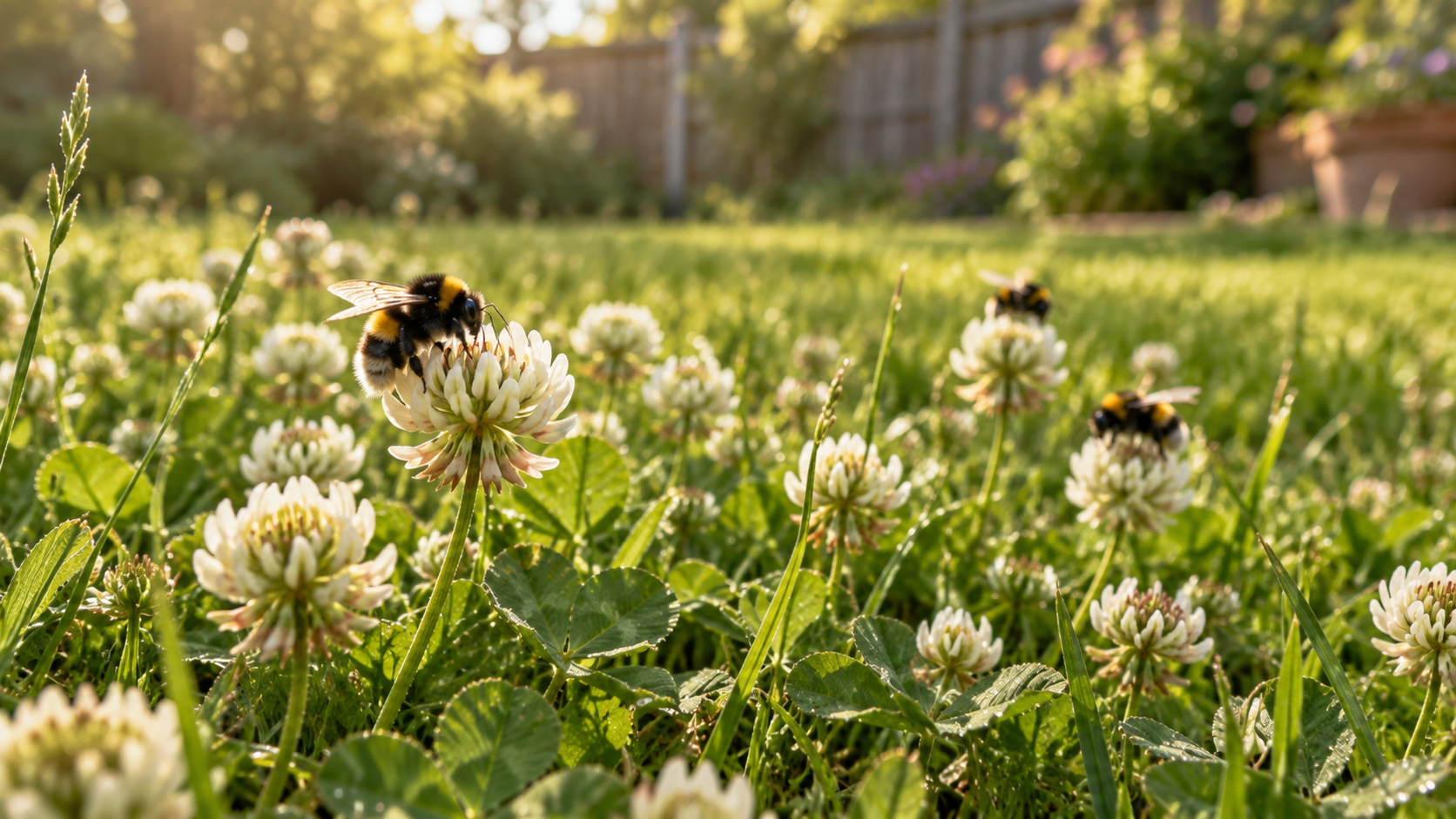
Clover fixes nitrogen from the air into the soil, which actually improves the grass growing alongside it — meaning you can stop applying lawn feed entirely. It stays green during dry spells when grass browns. It’s low-growing, so it doesn’t need cutting as frequently. And it flowers prolifically from May through September, providing consistent nectar for bumblebees and honeybees.
How to overseed with clover
The best time to overseed is late March to May, or September. You don’t need to dig up your existing lawn. Simply:
- Mow your lawn short (below 5cm)
- Scarify lightly with a rake to expose some bare soil
- Scatter clover seed at roughly 5g per square metre
- Water in and leave alone for two to three weeks
You can buy pure white clover seed or a bee-friendly lawn mix that combines clover with fine fescue grasses — these blended mixes tend to look more ‘traditional’ if you’re worried about neighbours’ reactions, while still providing good pollinator value. Suppliers like Thompson & Morgan, Suttons, and Pictorial Meadows all offer UK-appropriate mixes.
What doesn’t work: Don’t bother with clover in heavily shaded areas — it needs decent light to establish and flower. In deep shade, look at moss or creeping thyme instead.
Option 2: Wildflower Patches — What UK Soil Actually Needs
Wildflower meadows look beautiful on seed packet photographs. In practice, the gap between expectation and reality can be significant — particularly in UK gardens, where soil conditions are the make-or-break factor that most guides gloss over.
The soil fertility problem
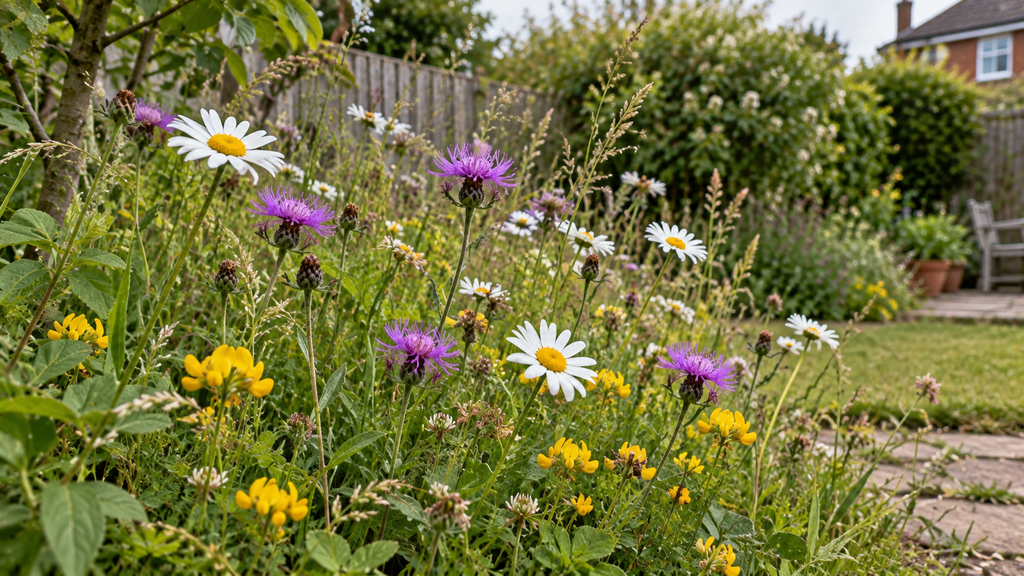
Most UK native wildflowers — yellow rattle, ox-eye daisy, knapweed, cowslip, bird’s-foot trefoil — evolved on low-fertility soils. Your average British garden soil, particularly if it’s been fed and composted for years, is often too rich for them. The result? Grasses dominate, wildflowers struggle, and after one season of patchy results many people give up.
The fix is either to strip the top 5–10cm of topsoil (exposing the nutrient-poor subsoil beneath) or to use yellow rattle — a semi-parasitic plant that weakens grass and gradually reduces soil fertility, making space for wildflowers over two to three seasons. It’s slower, but much less labour-intensive than topsoil removal.
Native wildflowers that reliably work in UK gardens
These species perform well across most UK regions and soil types:
- Ox-eye daisy (Leucanthemum vulgare) — robust, tall, excellent for bees and hoverflies
- Bird’s-foot trefoil (Lotus corniculatus) — low-growing, yellow flowers, loved by common blue butterflies
- Field scabious (Knautia arvensis) — tall purple flowers, excellent late-season nectar source
- Cowslip (Primula veris) — early spring, thrives on chalky or clay soils
- Ragged robin (Lychnis flos-cuculi) — ideal for damper ground, striking pink flower
- Knapweed (Centaurea nigra) — one of the most wildlife-valuable plants you can grow; tough and long-flowering
Pictorial Meadows and Emorsgate Seeds both supply high-quality UK native wildflower mixes with good guidance on soil type matching. Avoid generic wildflower mixes from DIY stores — they often contain non-native annual species that look great in year one and disappear entirely by year two.
Option 3: Low-Mow Grass Alternatives
Not everyone wants to go full wildflower. If you need a surface that can still take foot traffic — children running around, dogs, outdoor dining — but want to reduce maintenance and improve ecology, there are grass alternatives worth knowing about.
Fine fescue mixes
Fine-leaved fescues (Festuca species) grow more slowly than ryegrass, need cutting less frequently, and tolerate dry conditions well. A fine fescue lawn won’t be quite as lush-looking as a rye lawn, but it needs cutting perhaps once a fortnight rather than weekly, and withstands summer drought far better. It also works well mixed with clover.
Creeping thyme
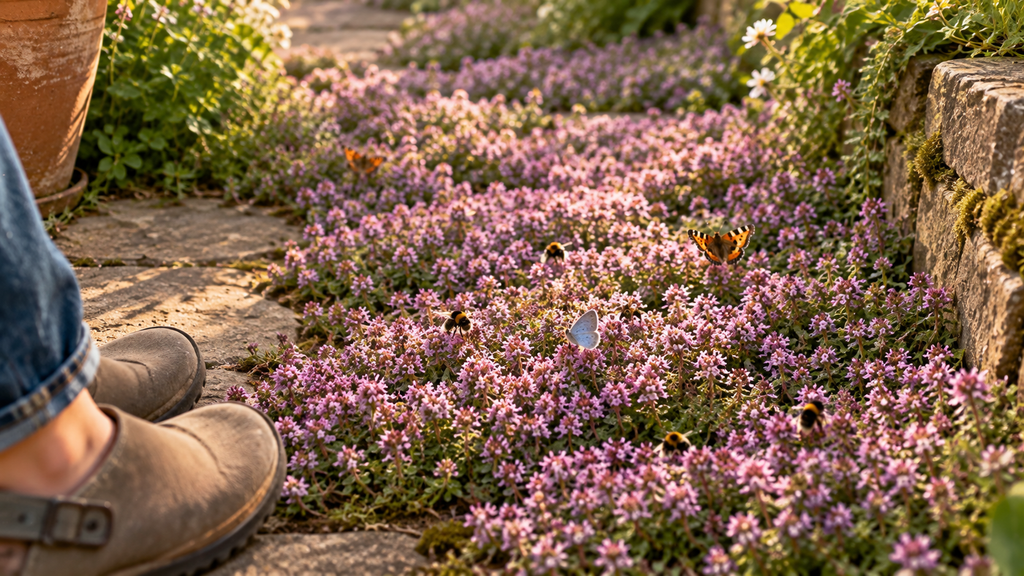
For sunny, well-drained spots, creeping thyme (Thymus serpyllum) makes a genuinely usable low-traffic surface that flowers pink-purple in summer and smells incredible when walked on. It needs virtually no mowing, tolerates drought, and is loved by bees. It won’t cope with heavy foot traffic or shade, but for a sun-facing front garden or path edging it’s an excellent choice.
Chamomile lawn
The non-flowering variety Chamaemelum nobile ‘Treneague’ is the classic lawn substitute for sheltered, well-drained spots. It’s more work to establish than clover or fescue and can be patchy in its first year, but once established it’s lovely — soft, fragrant, and almost maintenance-free. Honest caveat: it really doesn’t like heavy clay or waterlogged soil. If your garden holds water in winter, skip this one.
Regional Considerations: What Works Where in the UK
The UK’s climate varies significantly from south to north and east to west — and what works brilliantly in a sheltered Surrey garden may struggle in a windswept Yorkshire plot.
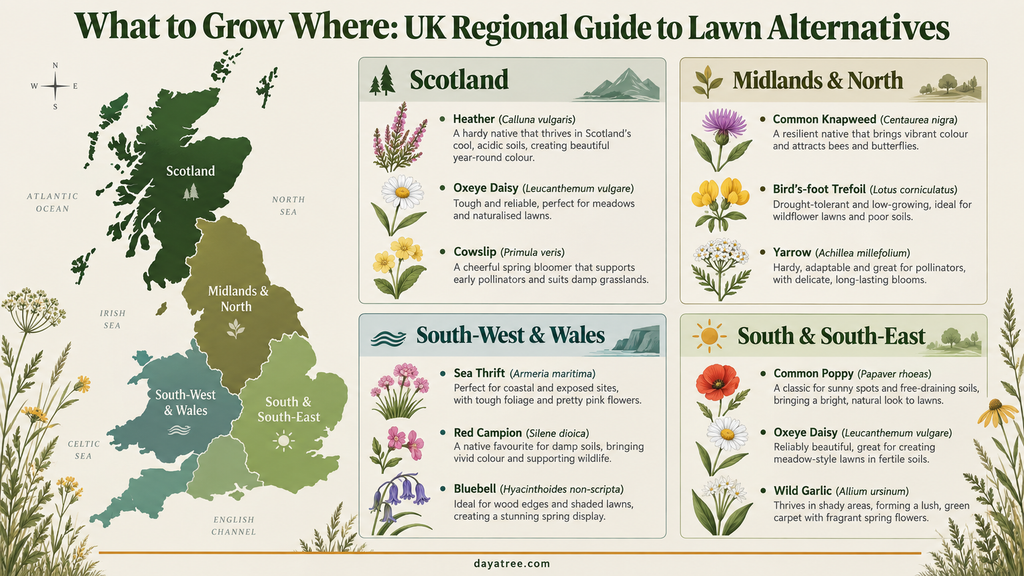
- South and south-east England: The widest options. Chalk grassland wildflowers (cowslip, salad burnet, dropwort) do particularly well on alkaline soils. Clover and thyme both thrive.
- South-west and Wales: Wetter, milder conditions. Ragged robin, meadow buttercup, and greater bird’s-foot trefoil suit these areas well. Clover establishes reliably.
- Midlands and North: Shorter growing seasons. Stick to robust natives — knapweed, ox-eye daisy, meadow cranesbill. Avoid Mediterranean herbs as lawn alternatives.
- Scotland: Focus on native species suited to acidic, cooler soils — devil’s-bit scabious, harebell, tormentil. Wildflower seed suppliers with Scottish-provenance mixes (like Scotia Seeds) are worth seeking out.
Getting Started: A Practical First Step
The most common mistake is trying to transform an entire lawn at once. It’s overwhelming, expensive, and if anything goes wrong (a late frost, a dry spell, an enthusiastic dog), you’ve lost the lot.
Instead, pick one area — ideally a patch that already struggles with grass, like a south-facing corner that dries out in summer, or a shady edge where the lawn is thin. Use that as your trial bed. Overseed it with a clover mix this spring, observe what happens, and expand from there in autumn or the following year.
The rewilding principle that the RHS keeps returning to is worth holding onto here: progress over perfection. A garden that’s 20% more wildlife-friendly than last year is a success. You don’t need to dig up everything to make a real difference.
The Complete Guide to Rewilding Your UK Garden (2026/ Wildlife Pond in a Small Garden: How to Do It Affordably / How to Turn Your UK Garden into a Wildlife Habitat

What to Buy and Where
A few UK suppliers worth knowing:
- Thompson & Morgan — good range of wildflower and clover mixes, UK-grown seed options
- Pictorial Meadows — Sheffield-based, excellent regional seed mixes, clear soil type guidance
- Emorsgate Seeds — specialists in native wildflowers, trade and retail
- Suttons Seeds — reliable clover and lawn alternative mixes, widely available