The Complete Guide to Rewilding Your UK Garden (2026)
As an Amazon Associate I earn from qualifying purchases and sometimes recommend products from other sellers at no extra cost you. For more details see my disclosure policy and privacy policy.
How to turn any outdoor space — from a window box to a half-acre — into a haven for wildlife, without giving up on beauty or practicality.
Three years ago I stood in my back garden and realised I’d been maintaining a green desert. Neatly mown grass, weed-suppressing membrane under the borders, a perfectly clipped box hedge. Tidy. Controlled. And almost completely silent — no bees, no butterflies, barely a bird.
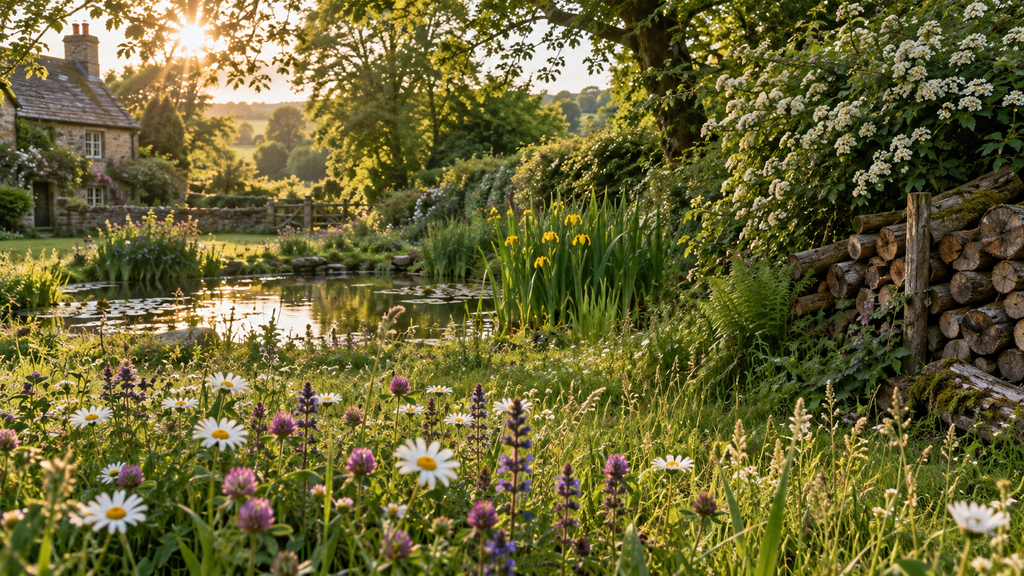
Since then, I’ve been slowly, deliberately rewilding it. I’ve replaced a third of the lawn with a wildflower meadow. I’ve let the back corner go gloriously scrappy. I’ve added a small wildlife pond, a log pile, and a hedgehog highway that connects our garden to our neighbour’s. And this spring, for the first time in years, I counted fourteen different pollinator species on a single afternoon.
If any of that sounds appealing — but also a little daunting — this guide is for you. We’ll cover exactly what rewilding means in a domestic context, why it matters ecologically, and most importantly, how to actually do it in a UK garden, whatever size you’re working with.
Free download
Get the Non‑Toxic Home Audit Checklist
A room‑by‑room checklist to help you spot what’s worth swapping in your home — and what’s not worth worrying about. Join the fortnightly newsletter and it’s yours.
No spam, unsubscribe any time.
| Quick answer Rewilding your garden means reducing control and increasing biodiversity — letting some areas grow wild, adding native plants, and creating habitats for insects, birds, and small mammals. You don’t need a large garden or a big budget. You need a willingness to let go of some of the tidiness. |
What Does ‘Rewilding’ Actually Mean in a Garden Context?
Rewilding as a concept originated in large-scale conservation — think Knepp Estate in West Sussex, where Isabella Tree and Charlie Burrell famously walked away from conventional farming and allowed the land to regenerate naturally. On that scale, rewilding means reintroducing apex predators, removing fences, and stepping back entirely.
In a domestic garden, it means something far more modest but no less meaningful. Garden rewilding is about shifting from control to collaboration — working with nature’s inclinations rather than against them. That might mean:
- Letting a patch of grass grow long rather than mowing it short
- Planting natives that wildlife has evolved alongside, rather than exotic cultivars bred for looks
- Adding structural features — log piles, ponds, stone stacks — that provide habitat
- Stopping or reducing pesticide and herbicide use
- Connecting your garden to neighbouring spaces so wildlife can move freely
The Royal Horticultural Society named rewilding as one of its headline trends for 2026, and the evidence supports why: the UK has lost 97% of its wildflower meadows since the 1930s, and over 40% of Britain’s wildlife species have declined since 1970. Gardens collectively cover more land than all of England’s nature reserves combined. What we do in them matters.
The Ecological Case for Rewilding Your Garden
Gardeners are sometimes resistant to rewilding because it sounds like ‘doing less’ or ‘letting things go’. In practice, it’s neither. Rewilding requires active thought about what you’re adding and why — it just involves different actions to traditional gardening.
Here’s what the science tells us about what’s at stake:
Pollinators Are in Crisis
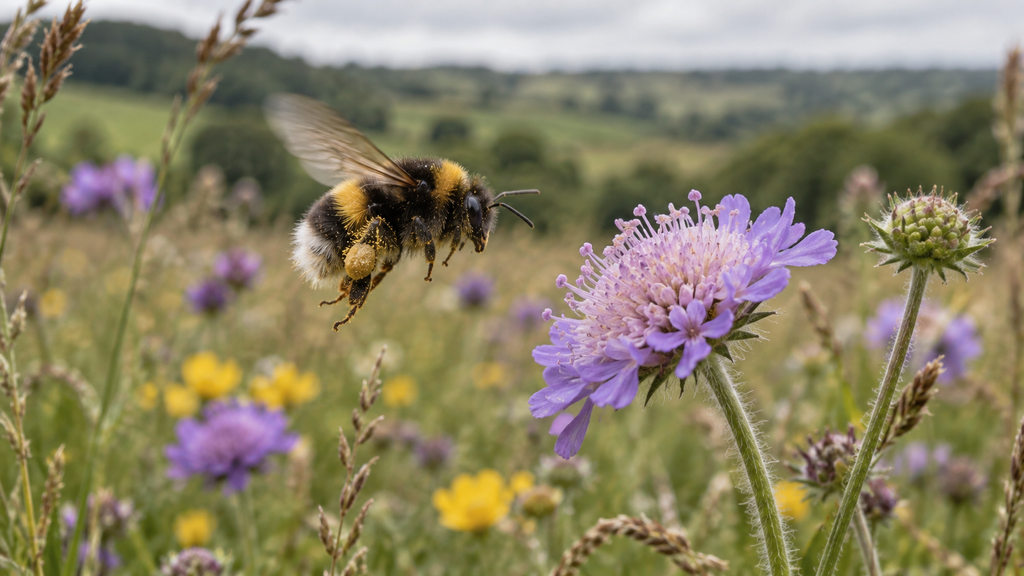
The UK has lost around 13 native bee species in recent decades, and 35 more are at risk of extinction. Pollinators are responsible for one in three bites of food we eat. A garden with diverse native flowering plants — especially those that flower in early spring and late autumn when food is scarce — can meaningfully support local pollinator populations.
Hedgehogs Are Declining Rapidly
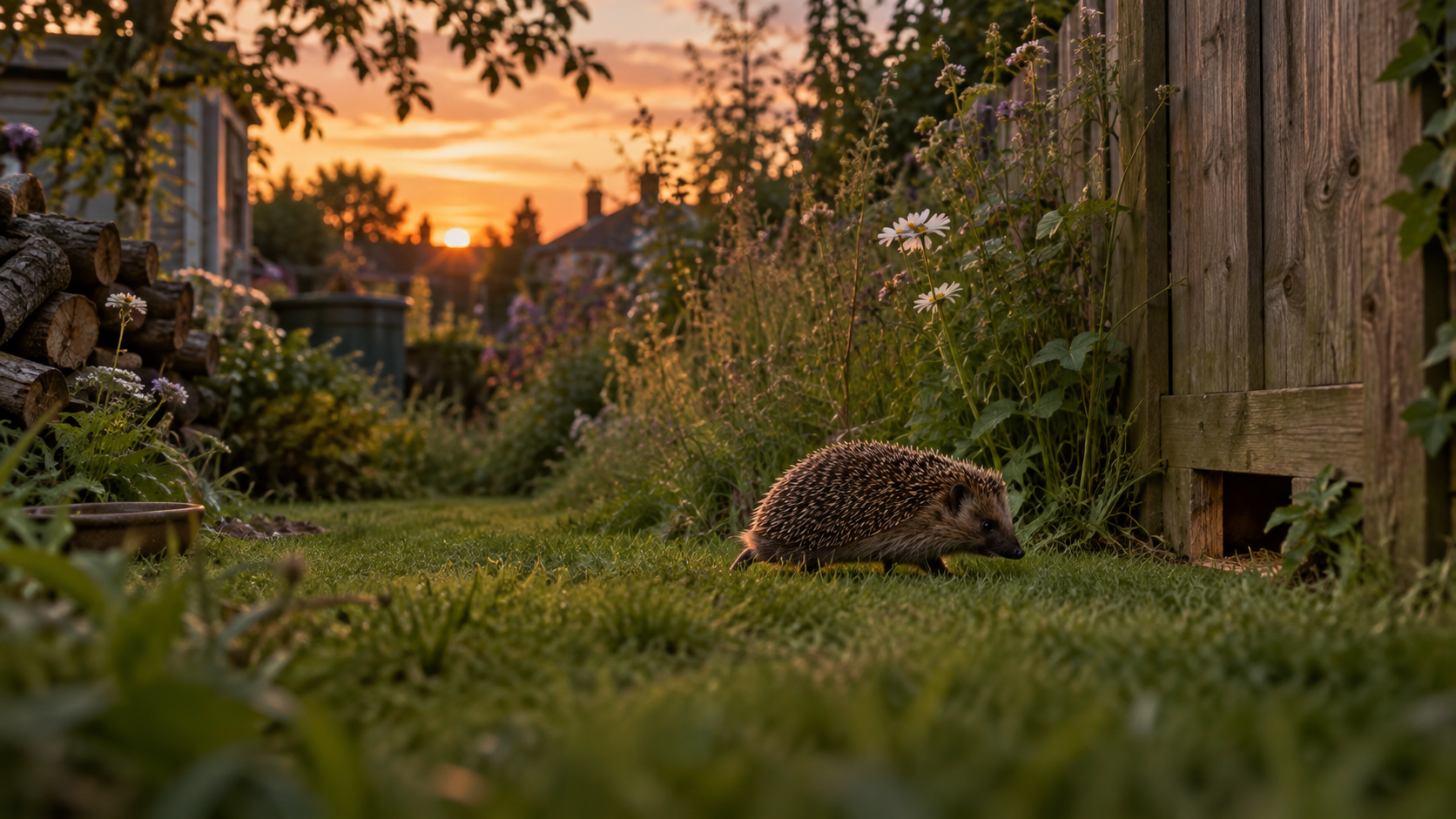
Hedgehog numbers have declined by around 50% in rural areas since 2000. One of the biggest factors is garden fragmentation — solid fencing that prevents hedgehogs from moving between gardens to find food and mates. A 13cm gap at the base of a fence (the hedgehog highway principle) costs nothing and could be the difference between a thriving local population and a declining one.
Birds Need More Than a Bird Table
Putting out seed is a good start, but birds need habitat — dense shrubs for nesting, insect-rich borders for feeding, and berry-bearing plants for winter food. A garden that offers all three is far more valuable than one with only a feeder.
The good news: all of this is achievable in even a modest UK garden. You don’t need half a hectare. You need intention and a willingness to let some things be.
Where to Start: A Rewilding Framework for UK Gardens
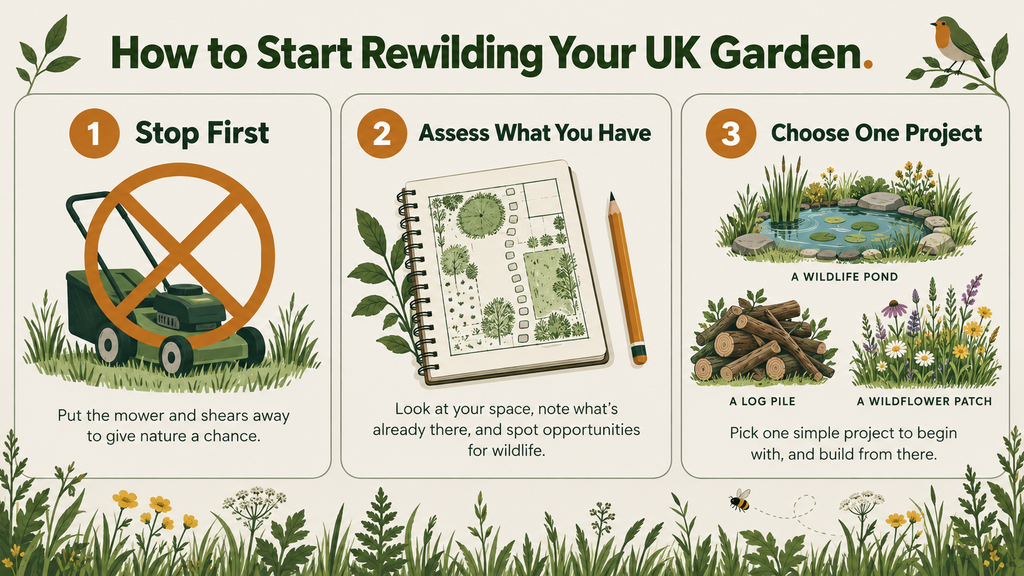
The most common mistake with garden rewilding is trying to do everything at once and feeling overwhelmed. A better approach: identify your highest-impact interventions first, then build gradually.
Here’s the framework I use, and recommend:
Step 1: Stop Before You Start
Before adding anything new, stop removing things. Stop mowing one section of the lawn. Stop pulling out the ‘weeds’ in a corner border. Stop deadheading the seed heads that birds love. Permit yourself to observe what shows up when you step back — you may be surprised by what was there all along.
This also applies to pesticide use. If you’re currently using slug pellets, weedkiller, or insecticide, stopping is the single most impactful thing you can do for garden biodiversity.
Step 2: Assess What You’ve Got
Every garden is a different starting point. Before investing in plants, take stock:
- What existing plants do you have, and are any of them native or wildlife-friendly?
- What are the light conditions — full sun, partial shade, or deep shade?
- What’s your soil type — clay, sandy, chalk, or loam? (This determines what will thrive)
- What are your boundaries — solid fence, hedge, wall, or open?
- Do you have any existing habitat features — compost heap, log pile, pond?
I spent an afternoon with a notebook just walking round and noting what I saw. It was more useful than any amount of planning I did in the abstract.
Step 3: Choose Your First Rewilding Project
Rather than trying to rewild the whole garden simultaneously, pick one project to focus on first. The best options for most UK gardens, in rough order of impact and ease:
- No-mow area: stop mowing a section and see what naturally establishes itself over spring and summer
- Native planting strip: replace a border or bed with UK-native species chosen for your conditions
- Wildlife pond: even a small pond is one of the single highest-impact things you can add
- Log pile or bug hotel: low-effort, immediately usable habitat
- Hedgehog highway: one hole in one fence, coordinated with neighbours
Native Plants: The Backbone of a Wildlife-Friendly Garden
If there’s one guiding principle in rewilding, it’s this: native plants support native wildlife because they have evolved together over thousands of years. A native oak tree supports over 500 species of invertebrate. A non-native ornamental pear might support fewer than a dozen.
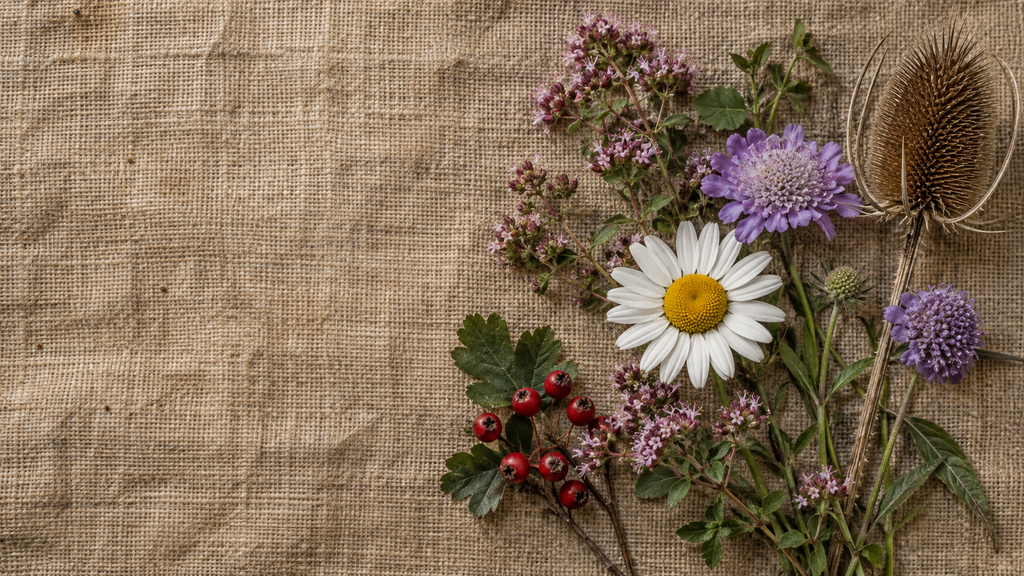
This doesn’t mean every plant in your garden needs to be native — some well-chosen non-natives, particularly single-flowered varieties (rather than blowsy doubles that pollinators can’t access), are valuable. But the backbone of a rewilded garden should be native.
Best Native Plants for UK Pollinators
The following are reliable, widely available, and genuinely valuable for pollinators across most UK regions:
- Ox-eye daisy (Leucanthemum vulgare) — a meadow classic, flowers June–September
- Field scabious (Knautia arvensis) — loved by bumblebees, flowers June–October
- Teasel (Dipsacus fullonum) — dramatic and architectural, seeds attract goldfinches
- Hawthorn (Crataegus monogyna) — hedgerow staple, blossom for pollinators, berries for birds
- Wild marjoram (Origanum vulgare) — excellent for butterflies, can also be used in cooking
- Yellow rattle (Rhinanthus minor) — parasitises grasses, allowing wildflowers to establish
- Devil’s bit scabious (Succisa pratensis) — critical for the endangered marsh fritillary butterfly
A note on sourcing: wherever possible, source native plants from specialist UK nurseries rather than the generic ‘wildlife’ ranges at large garden centres, which are often cultivars rather than true species. The RHS has a list of recommended native plant suppliers.
For seeds, Thompson & Morgan and Suttons both stock good ranges of native wildflower seed mixes, and both have UK affiliate programmes if you’re looking for seeds with free delivery. For bare-root hedgerow plants, a local native plant nursery will almost always be better value than a national retailer.
The Lawn Question: To Mow or Not to Mow?
The conventional British lawn — fine-bladed, uniformly green, mown weekly to an even height — is one of the most biodiversity-hostile surfaces we maintain. It’s treated with fertiliser to encourage grass growth, weedkiller to discourage ‘weeds’ (many of which are valuable wildflowers), and mowed before anything can flower or set seed.
The good news is that you don’t have to rip it all out. A partial approach works well and is considerably less daunting:
Option 1: The No-Mow Patch
Stop mowing a section of your lawn — even just 1m x 1m — and observe what appears over the course of the season. In most UK gardens, you’ll see clover, self-heal, creeping buttercup, and possibly dandelions within weeks. All of these are excellent forage plants for bees.
No-mow May, the campaign run by Plantlife UK, encourages gardeners to avoid mowing throughout May to allow these plants to flower. The campaign data from 2023 found that unmowed lawns contained an average of 23 flowering plant species per plot.
Option 2: Replace Part of the Lawn with a Wildflower Meadow
A step further than no-mow: scarify or strip part of the lawn, reduce the fertility of the soil (wildflowers prefer poor soil), and sow a native wildflower mix suited to your conditions. This is a longer-term project — establishing a wildflower meadow properly takes two to three growing seasons — but the results are genuinely spectacular.
Yellow rattle is the key plant to include early: it parasitises grasses, reducing their vigour and allowing wildflowers to establish. Without yellow rattle, grasses tend to out-compete everything else.
Option 3: Replace the Lawn Entirely
If you’re ready for a more substantial change, consider what you actually want from the space the lawn occupies. For many UK families, a dedicated lawn serves mainly as a walking-through surface. Could part of that space become raised beds, gravel with low-growing thyme, a seating area with meadow edges, or a native ground cover like wild strawberry?
Creating Habitat: Log Piles, Bug Hotels, and the Small Stuff
Wildlife doesn’t just need food — it needs shelter. Habitat features are things you can add to any garden, any size, that create structure and refuge for invertebrates, amphibians, reptiles, and small mammals.
The Log Pile
A log pile is one of the most effective habitat additions you can make. Rotting wood is habitat for stag beetles, woodlice, centipedes, fungi, mosses, and lichens. A pile of logs from a pruned tree or sourced from a local arborist costs nothing and requires no maintenance — in fact, intervention is actively harmful. Leave it alone and let it decay.
Ideally: place it in a shady, damp spot. Partially bury the bottom logs to increase contact with soil. Include a mix of different wood species if possible.
Bug Hotels and Insect Habitats
A bug hotel can range from a carefully constructed wooden frame filled with bamboo canes, pine cones, and dried stems, to simply bundling up some hollow stems and hanging them on a south-facing wall. Solitary bees — which make up over 90% of UK bee species — are the main beneficiaries, using hollow stems to lay eggs.
One important caveat: commercially produced bug hotels are sometimes poorly designed (bamboo holes too wide, materials that rot too quickly). A well-made DIY version is usually better than a cheap shop-bought one. The key dimensions for solitary bee nesting tubes are 5–10mm diameter.
Leaf Piles and Compost Heaps
Leaf piles overwinter hedgehogs, slowworms, and frogs. A compost heap is one of the warmest spots in the garden in winter and supports a vast community of invertebrates that in turn feed everything else. Both require minimal effort to establish and maximum restraint to maintain — which is to say, leave them alone.
Adding Water: The Wildlife Pond
If I had to choose a single habitat addition for wildlife impact per square metre, it would be a pond. Ponds attract and support an extraordinary range of species — dragonflies, damselflies, frogs, toads, newts, birds coming to bathe and drink, and a web of invertebrates that underpins everything else.
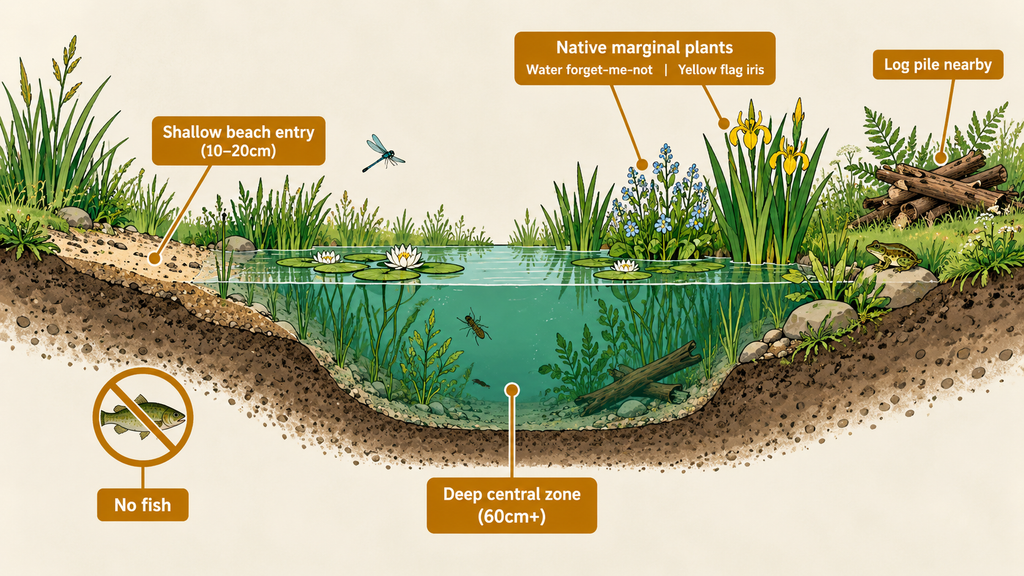
You don’t need a large garden for a pond. I’ve seen thriving garden ponds in containers, half-barrels, and 2m x 1m dug-out spaces. The key principles:
- At least one gradual ‘beach’ slope so wildlife can enter and exit safely
- A mix of depths — shallow margins (10–20cm) and a deeper central area (at least 60cm) to avoid freezing solid in winter
- Native aquatic plants — water forget-me-not, water mint, yellow flag iris — not invasive non-natives like Canadian pondweed
- No fish in a wildlife pond: they eat frog spawn and invertebrate larvae
- No pump or filter: a wildlife pond is self-regulating
A well-established wildlife pond takes about three years to reach its ecological peak. Year one: plants establish. Year two: invertebrates colonise. Year three: frogs, toads, and newts arrive. Be patient — it’s worth it.
Rewilding for Food: The Foraging Garden
One of the most satisfying aspects of rewilding is that it doesn’t mean giving up on using your garden productively. A rewilded garden can produce edible food — not through conventional growing, but through planting species that are both wildlife-valuable and human-edible.
Elder, blackberry, hawthorn, and wild garlic are all native or naturalised species that support wildlife and produce food. A small patch of wood sorrel, chickweed, or hawthorn leaves provides salad ingredients through the spring. Foraging from a garden you’ve rewilded isn’t contradictory — it’s an extension of the same relationship with the land.
Common Rewilding Mistakes (and How to Avoid Them)
Most rewilding mistakes come from moving too fast or misunderstanding what wildlife needs. The most common:
Planting the Wrong ‘Native’ Plants
Many plants sold as ‘wildlife-friendly’ are cultivars — bred for showier flowers, which often have reduced or absent nectar and inaccessible pollen. A double-flowered Prunus ‘Kanzan’ is useless to a bee. Check that what you’re planting is a true species, not a named cultivar. When in doubt, buy from a specialist native plant nursery and look for the RHS Plants for Pollinators logo.
Tidying Up at the Wrong Time
Autumn and winter tidying — cutting back borders, removing dead stems, raking leaves — destroys the overwintering habitat of countless invertebrates and removes seed heads that birds need. If you need to tidy, cut back stems to 30–40cm rather than to the ground, and do it in March rather than October.
Expecting Instant Results
A rewilded garden establishes over years, not weeks. The first season may look scrappy. The third season will look intentional. By the fifth, you’ll have something genuinely special. Take photos from the same spot each year — the change is remarkable when you look back.
Rewilding on a Budget: What Costs and What Doesn’t
One of the best things about rewilding is that many of its most impactful elements are free:
- Stopping mowing: free
- Stopping pesticide use: actually saves money
- Log pile from pruned trees: free
- Leaf pile: free
- Hedgehog highway: free (just a gap in a fence)
- Compost heap: cheap or free with salvaged pallets
The costs tend to come with plants and pond construction. Here’s how to keep those down:
- Swap plants with neighbours and local gardening groups (Facebook Marketplace and Freecycle are full of divisions and seedlings)
- Grow wildflowers from seed rather than buying plants — a packet of native wildflower seed costs around £2–4 and will cover several square metres
- Use a second-hand rigid pond liner (these appear regularly on local selling sites) or a flexible butyl liner cut to size
- Join a local wildlife gardening group — many run seed swaps and plant giveaways
| A note on buying native plants Thompson & Morgan, Suttons Seeds, and Sarah Raven all stock good ranges of native species with UK delivery. For hedgerow plants, a local native plant nursery or bare-root autumn sale will almost always offer better value than buying pot-grown from a garden centre. |
What to Do Right Now: A Seasonal Starting Guide
Rewilding is a year-round practice, but each season has its own priorities. Here’s where to start depending on when you’re reading this:
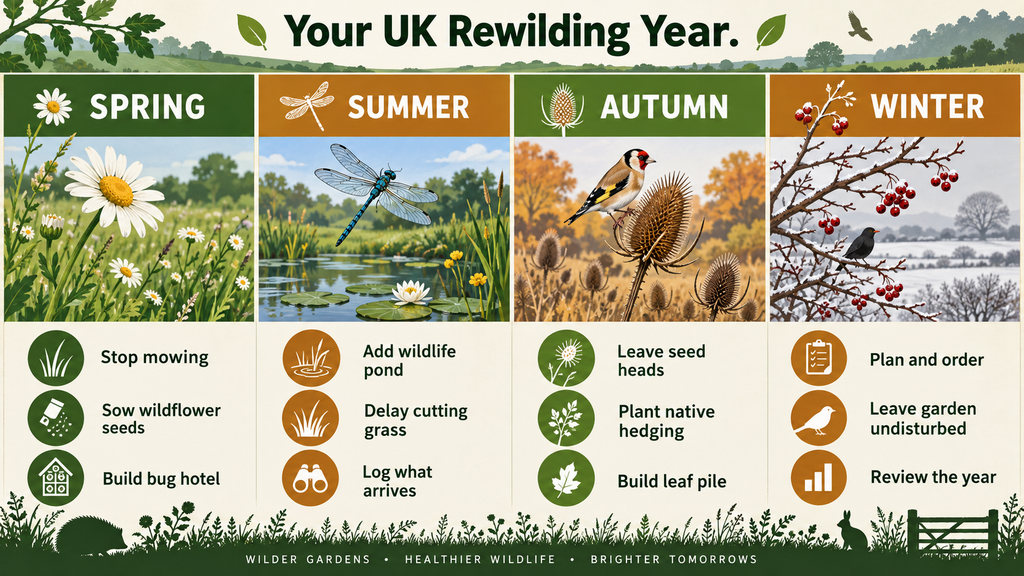
Spring (March–May)
- Stop mowing at least one lawn section for No-mow May
- Sow native wildflower seeds direct into prepared ground
- Plant bare-root native hedgerow species before the ground dries out
- Build or install a bug hotel on a south-facing surface
- Check fences for hedgehog-sized gaps and create highways with neighbours
Summer (June–August)
- Observe and identify what’s visiting your rewilded areas — keep a wildlife log
- Delay cutting long grass until late August to allow seeds to set
- Add a wildlife pond or water feature
- Plant autumn-flowering natives (devil’s bit scabious, teasel) to extend the season
Autumn (September–November)
- Leave seed heads standing for birds through winter
- Create leaf piles in quiet corners for hedgehog hibernation
- Plant bare-root native trees, shrubs, and hedgerow plants
- Order yellow rattle seed for spring sowing in your meadow area
Winter (December–February)
- Plan your rewilding projects for the coming year
- Order seeds and plants while choice is best
- Leave the garden largely undisturbed — the ‘messy’ winter garden is full of life
The Rewilded Garden: What You’re Really Creating
A rewilded garden is not an untended garden. It’s a garden with a different kind of intention — one that measures success not in uniformity or tidiness, but in the number of species present, the sound of bees in the afternoon, and the moment your child crouches down to watch a hedgehog cross the lawn at dusk.
It’s also not an all-or-nothing commitment. You can have a tidy patio and rewilded borders. You can have a formal vegetable patch and a wildlife pond. You can mow two-thirds of your lawn and leave one strip long. Rewilding is not about abandoning your garden — it’s about expanding what you consider its purpose to be.
Every native plant, every log pile, every un-mowed strip connects to a wider network of habitat that is genuinely struggling. The UK’s wildlife is in crisis. But the UK’s gardens cover 1.7 million acres. What happens in them matters — and it’s entirely in our hands.
| Summary: The Daya Tree Rewilding Checklist 1. Stop mowing one section of lawn. 2. Remove pesticides from your practice. 3. Add one native plant per season that supports pollinators. 4. Create one habitat feature (log pile, bug hotel, or pond). 5. Make one hedgehog highway. 6. Observe and record what arrives. |
Explore the Rest of the Rewilding Series
This post is the pillar of Daya Tree’s wildlife gardening series. Each cluster post below goes deeper on a specific topic mentioned here — use them as the next step when you’re ready to take action on any particular area:
- How to start a wildlife-friendly garden from scratch — for complete beginners
- No-mow May: what it is, why it matters, and what to do instead of mowing
- UK native plants for pollinators: a species-by-species guide
- How to build a hedgehog highway (with free downloadable template)
- Log piles, bug hotels, and leaf piles: a DIY guide to garden wildlife habitat
- Replacing your lawn: clover mixes, wildflower patches, and what actually works in UK soil
- Native hedging vs. fencing: costs, wildlife value, and how to plant
- Growing a foraging garden: what to plant for a harvest you can eat
- Wildlife pond in a small garden: how to do it affordably
Further reading: RHS Plants for Pollinators | Plantlife No-mow May | Woodland Trust Native Trees | People’s Trust for Endangered Species (hedgehogs)
Free Download
Get the Non-Toxic Home Audit Checklist — free
A room-by-room PDF guide for UK households, with red, amber & green ratings for the most common household products. No overwhelm — just practical swaps, at your own pace.
- Kitchen — cookware, food storage, cleaning products
- Bathroom — personal care, razors, toothpaste
- Laundry — detergents, fabric softener, dryer sheets
- Children’s items — wipes, bath toys, bedding
- General home — candles, paint, air quality
No spam, ever. Unsubscribe any time. Your details are kept private.