How to Turn Your UK Garden into a Wildlife Habitat (Even If It’s Small)
As an Amazon Associate I earn from qualifying purchases and sometimes recommend products from other sellers at no extra cost you. For more details see my disclosure policy and privacy policy.
By Nikki | Updated May 2026 | Sustainable Gardening, Rewilding
I used to think a “wildlife garden” meant having a large rambling estate somewhere in the countryside, the kind of place that practically rewilded itself. My own garden — a semi-detached in South Wales, paved over by a previous owner, hemmed in by fences — felt about as far from wildlife-friendly as you could get.
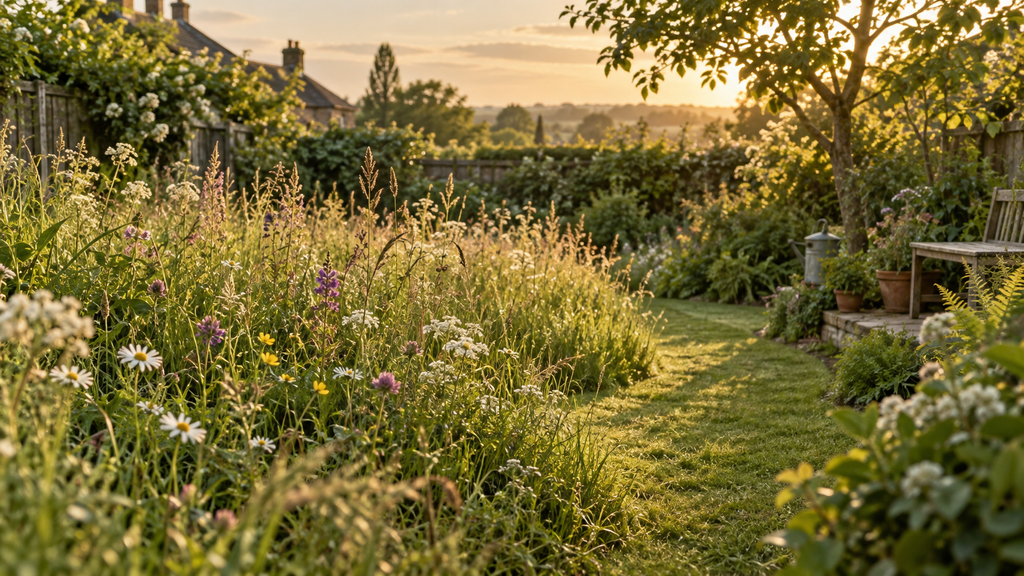
Then I pulled up two paving slabs. Within a fortnight, a frog moved in.
That experience taught me something the gardening books don’t always say clearly enough: wildlife doesn’t need perfection. It needs opportunity. And even the most ordinary UK garden can provide it, if you know where to start.
Free download
Get the Non‑Toxic Home Audit Checklist
A room‑by‑room checklist to help you spot what’s worth swapping in your home — and what’s not worth worrying about. Join the fortnightly newsletter and it’s yours.
No spam, unsubscribe any time.
This post walks you through the practical, low-cost ways to turn your outdoor space into a genuine habitat — whether that’s a postage-stamp patio in Manchester, a terraced garden in Bristol, or a larger plot in rural Wales. No rewilding estate required.
Why UK Gardens Matter More Than You Think
Britain has lost more than half its biodiversity in the last 50 years. Hedgehog numbers have declined by roughly 75% since the 1950s. One in six native bee species faces extinction. These are national statistics, but they play out at a hyper-local level — in the gardens, streets, and green spaces of every UK town and village.
Collectively, UK gardens cover around 400,000 hectares — more than all our National Nature Reserves combined, according to the Royal Horticultural Society (RHS). That’s an extraordinary resource, mostly untapped.
When you create habitat in your garden, you’re not just helping the odd passing bee. You’re contributing to a network of green corridors that allow species to move, feed, and breed across fragmented landscapes. In that sense, your garden — however small — is genuinely consequential.
The Four Things Wildlife Needs (and How to Provide Them)
Every animal, insect, and bird needs the same four things: food, water, shelter, and safe places to breed. The good news is that you can provide all four without spending much money, and in many cases without spending anything at all.
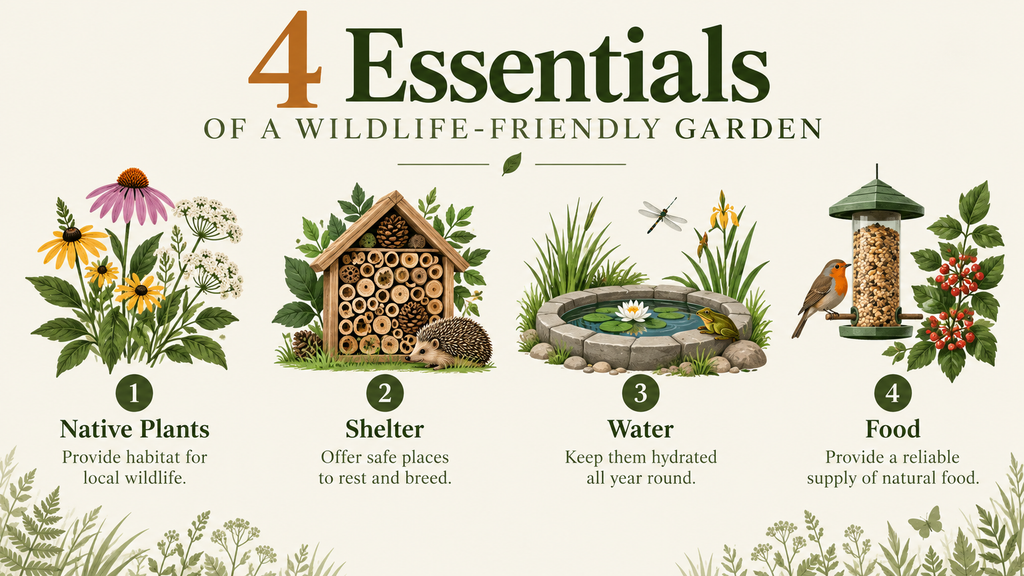
1. Food: Grow Plants That Work
The single most impactful thing you can do for wildlife in your UK garden is grow native plants — or at least plants that support native insects. The reason is simple: insects evolved alongside native plants over thousands of years, and many species can only feed on specific plants or plant families. A garden full of exotic ornamentals may look beautiful but function as a near-desert for wildlife.
For UK gardens, I’d start with these:
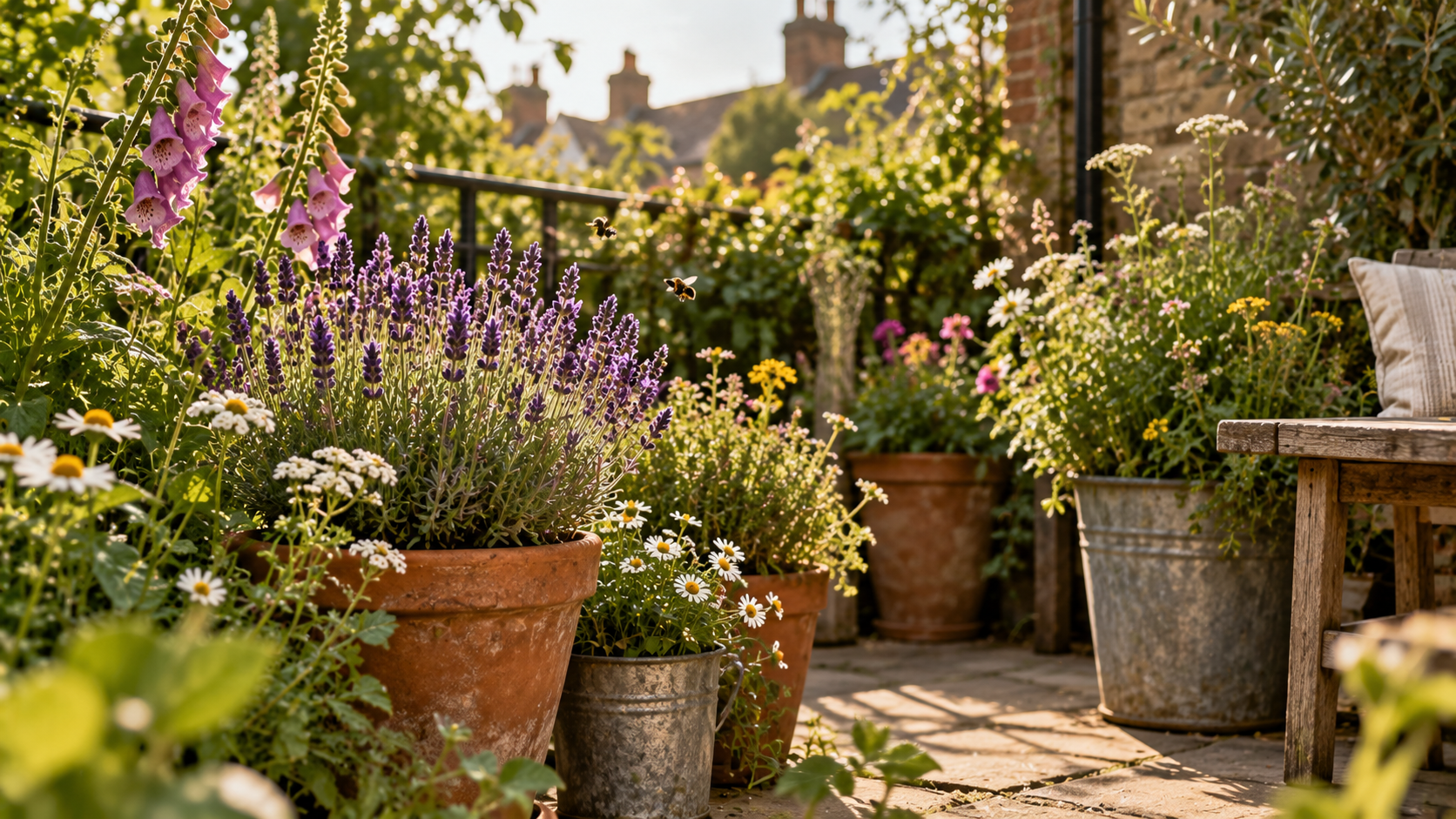
For pollinators: Lavender, borage, single-flowered dahlias, foxglove, knapweed, and any of the native wildflowers — ox-eye daisy, field scabious, yellow rattle. The RHS Perfect for Pollinators list is a free and genuinely useful resource for choosing what to plant where.
For birds: Berry-bearing shrubs like elder (Sambucus nigra), hawthorn, rowan, and holly provide food from late summer through winter when other sources run out. Sunflowers left to go to seed are magnets for goldfinches.
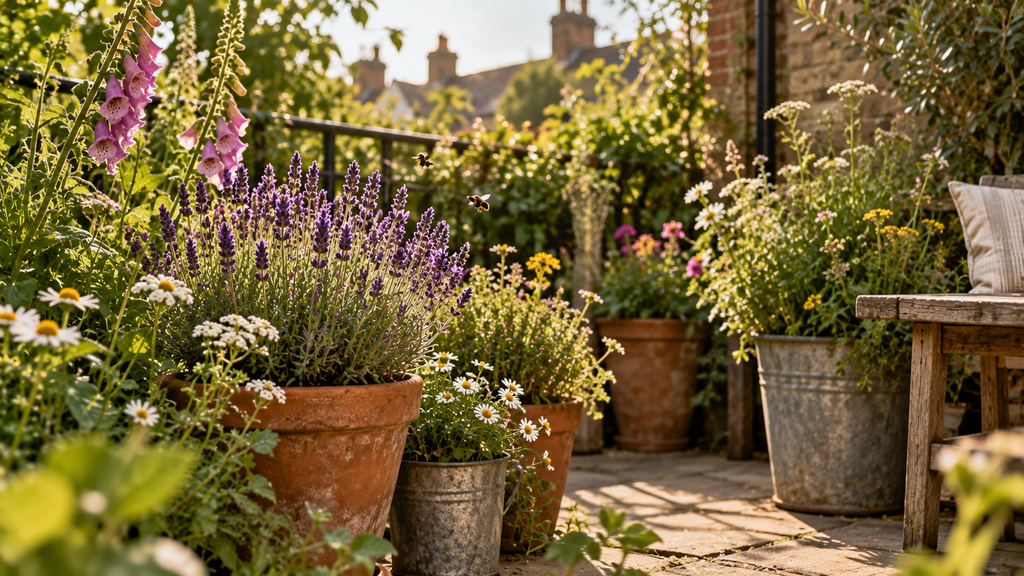
For moths and butterflies: Nettles — yes, nettles — are the larval food plant for red admiral, peacock, and small tortoiseshell butterflies. A patch in a corner you don’t use is one of the cheapest things you can do for UK butterfly populations.
One thing I changed in my own garden: I stopped deadheading quite so religiously. Seed heads left standing through autumn and winter feed finches and other birds, and they look beautiful with frost on them. What looks untidy to a tidy-minded gardener looks like a buffet to a long-tailed tit.
2. Water: A Source for Every Season
Garden wildlife needs water year-round, not just in summer. A shallow dish of water on the ground, refreshed every few days, will attract far more wildlife than an ornate bird bath mounted on a pedestal — because many insects, amphibians, and ground-feeding birds can’t access a raised bath at all.
If you want to go further, even a small wildlife pond — dug with a spade into a sunny corner, lined with butyl rubber, and edged with native marginal plants — can be transformational. I put in a pond measuring roughly 1.5 metres by 1 metre, and within the first summer I had common frogs, pond skaters, water boatmen, and a pair of mallards who turned up to inspect and decided it was below their standards. Progress.
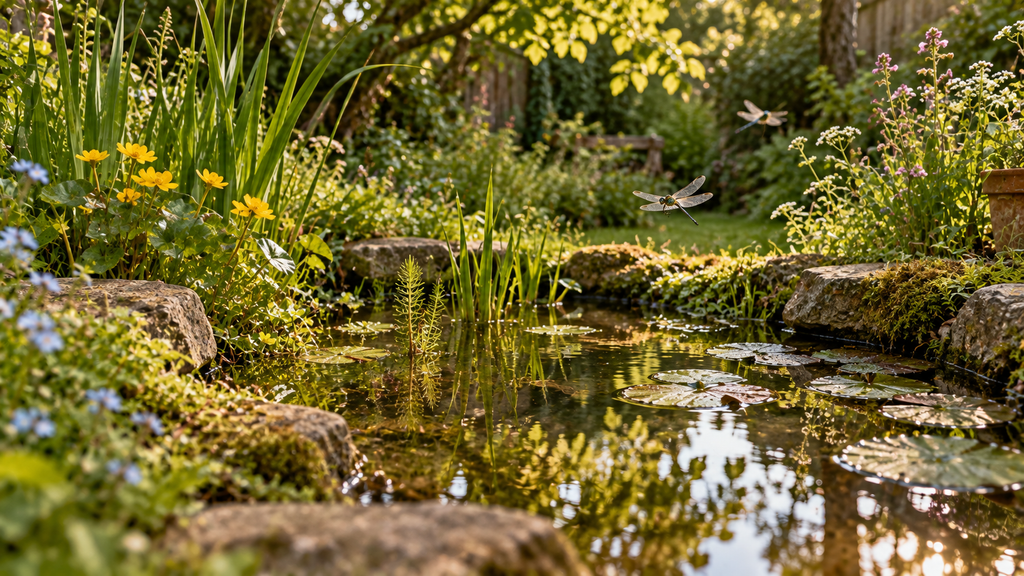
Key tips for a UK garden pond:
- Slope the edges gently so creatures can climb out — a steep-sided pond is a trap
- Add oxygenating plants like hornwort or water starwort rather than a pump
- Never add fish if you want it to support amphibians and invertebrates — fish eat frogspawn and tadpoles
- Fill it with rainwater where possible, or tap water left to stand for 24 hours
If you genuinely have no space for a pond, a half-barrel or even a washing-up bowl sunk into the ground can serve as a micro-pond. It’s not nothing.
3. Shelter: The Value of Mess
This is where UK gardeners — myself included — have historically gone wrong. We tidy too much.
Leaf litter, log piles, long grass, and seed heads all serve as overwintering habitat for insects, frogs, toads, slow worms, and hedgehogs. When we clear them in autumn, we destroy the habitats that make a functioning garden ecosystem possible in spring.
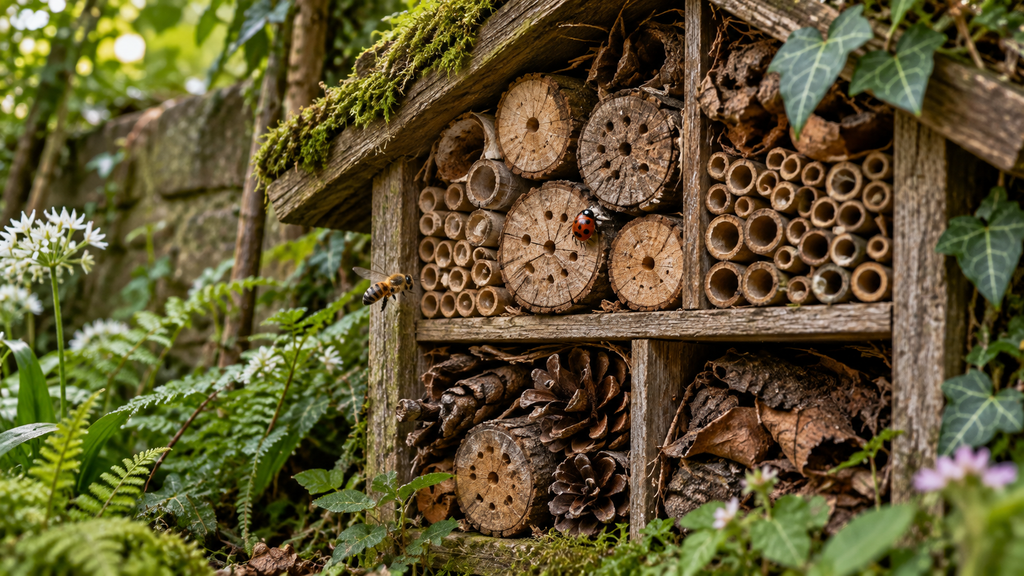
Some specific shelter structures worth adding:
Log pile: Stack logs of varying sizes in a shady corner and leave them to rot. Stag beetles (increasingly rare in the UK) need decaying wood to complete their life cycle. Even if you don’t have stag beetles locally, rotting wood hosts hundreds of other invertebrate species.
Leaf pile: Simply rake autumn leaves into a corner under a hedge or behind a shed. Hedgehogs will use this to hibernate. So will slow worms and grass snakes (if you’re lucky enough to have them).
Bug hotel: A structured stack of hollow stems, pine cones, bamboo sections, and corrugated cardboard provides nesting sites for solitary bees and lacewings. You can buy these or make them from materials you’d otherwise throw away. The key is to place them in a south-facing position, off the ground, protected from rain — not, as I once did, in a north-facing damp corner where nothing moved in except woodlice.
Long grass: Even a 50cm square patch of uncut grass in a sunny spot provides habitat for grass-hoppers, beetles, and a range of spider species that are essential food for birds. No-Mow May — the campaign run by Plantlife UK — has demonstrated clearly that even a single month of not cutting produces measurable benefits for insects.
4. Safe Breeding Spaces
For wildlife to actually thrive rather than just visit, it needs places to breed. This means reducing the sources of disturbance and threat, as well as adding the right structures.
For birds: Nest boxes should be put up in late winter — by February if possible, since some species begin prospecting early. Different box sizes suit different species: a 25mm entrance hole suits blue tits, a 28mm hole suits great tits, and an open-fronted box suits robins and spotted flycatchers. Position boxes away from direct afternoon sun and out of reach of cats.
For hedgehogs: The biggest barriers to hedgehog movement in UK suburban gardens are fences and walls. A gap of just 13cm x 13cm at the base of your fence — the size of a CD case — allows hedgehogs to pass through. Coordinating with neighbours to create joined-up access across several gardens significantly increases the value to local hedgehog populations. The British Hedgehog Preservation Society has a free downloadable template for a hedgehog highway sign to fix next to your gap.
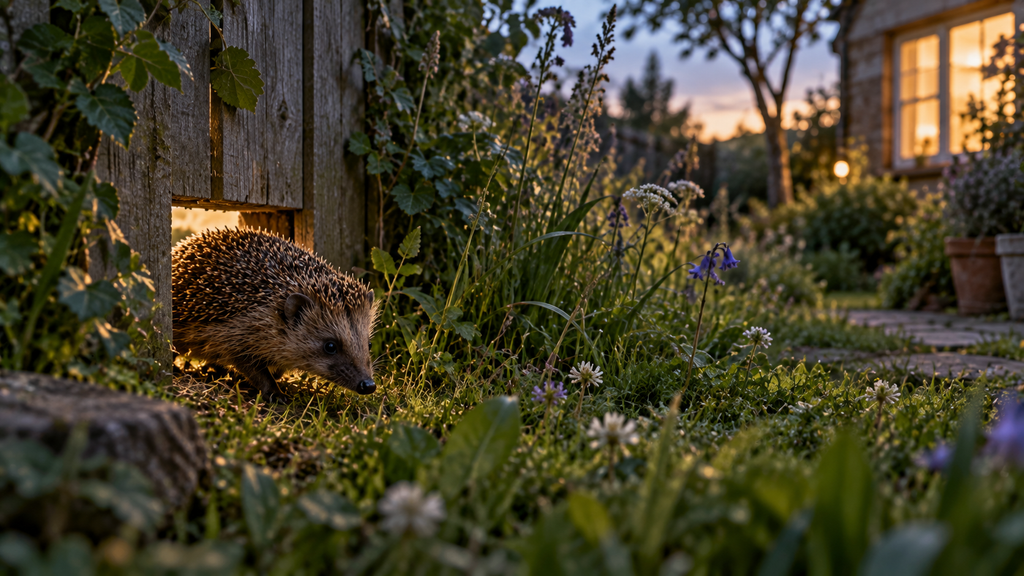
For amphibians: A pond is the most important thing, but also check that your garden doesn’t have open drains, deep holes, or netting close to the ground where frogs and toads can become trapped.
For bees: Solitary bees (which make up the vast majority of UK bee species) don’t live in hives — they nest in bare soil, hollow stems, or holes in wood. Leave a patch of bare earth somewhere sunny. Don’t mulch everything. Allow a few stems to remain hollow after cutting back plants in winter.
Quick Wins: What to Do This Week
If you’ve read this far and want to start immediately, here’s where to put your energy first — in order of impact per effort.
1. Stop mowing one patch of lawn. Even 1 square metre of long grass in a sunny spot will make a measurable difference within weeks.
2. Put out a shallow dish of water. Clean it and refill it every two days. Cost: zero, if you use an old saucer.
3. Build a log pile. Any fallen wood, old fence posts, or timber from a DIY project works. Stack it loosely in a shady spot and leave it alone.
4. Add one native plant. A pot of native wildflower plug plants from a UK nursery costs around £5–8. Ox-eye daisies, foxgloves, and knapweed are widely available and effective.
5. Cut a hedgehog gap in your fence. Talk to your neighbours first, then take a jigsaw to the bottom of a fence panel. Fifteen minutes’ work, potentially significant for local hedgehog survival.
What I Learned from Doing This Wrong First
I’ll be honest: my first wildlife garden attempt was a moderate disaster. I bought a bag of “wildflower seeds” from a petrol station, scattered them optimistically on my heavy clay soil in August, and wondered why nothing happened.
Here’s what I know now that I didn’t know then:
Timing matters. Most wildflower seeds need a cold stratification period — they germinate naturally in spring after experiencing winter. Autumn sowing on prepared soil works better than spring sowing for most UK native species.
Soil prep matters. Wildflowers often do worse on rich, improved soil. They evolved on poor, thin ground. If you’re sowing into a lawn or existing bed, the less fertile the soil, the better your results.
Not all “wildflower” products contain UK natives. Check the species list carefully — some cheap mixes contain non-native ornamentals that look similar but have no ecological value for UK insects.
Patience matters more than anything. A rewilded garden takes two to three years to begin showing results. The first year, I thought I’d failed. By year three, I had five species of bumblebee foraging in the garden simultaneously, which felt like something close to a miracle.
Going Further: Connecting to the Bigger Picture
Your garden doesn’t exist in isolation. The more your neighbours adopt even some of these practices, the more effective all of your efforts become — wildlife needs connected habitat, not individual islands.
Some UK-specific resources worth knowing about:
- RHS Perfect for Pollinators: A free, evidence-based plant list maintained by the RHS, searchable by garden type and plant size. Available at rhs.org.uk.
- Woodland Trust: Free tree packs for schools and community groups, and a range of resources on creating garden habitats. woodlandtrust.org.uk.
- British Hedgehog Preservation Society: Everything you need to know about supporting hedgehogs, including the hedgehog highway template. britishhedgehogs.org.uk.
- Plantlife’s No Mow May: Annual campaign with free resources on managing lawn for wildlife. plantlife.org.uk.
- The Wildlife Trusts: Local trust network with county-specific wildlife gardening advice and volunteer opportunities. wildlifetrusts.org.
The Bottom Line
A wildlife-friendly garden doesn’t require a complete redesign, a large budget, or a horticulture qualification. It requires a shift in how you think about what a garden is for.
Leave a bit more. Cut a bit less. Add water. Add some native plants. Make a gap in the fence.
The wildlife will find you. In my experience, it finds you faster than you expect, and the moment it does — the first frog, the first hedgehog noseprint on the shed door, the first bumblebee working its way along a row of borage — it’s genuinely difficult to describe without sounding like someone who has lost perspective.
Perhaps I have. But my garden now has far more life in it than it did when it was a patio, and I think that matters.
The Complete Guide to Rewilding Your UK Garden (2026) / UK Native Plants for Pollinators: A Species-by-Species Guide / Native Hedging vs. Fencing: Costs, Wildlife Value, and How to Plant
Nikki Piggott writes about sustainable living, gardening, and slow food from South Wales. All recommendations on this site are based on personal experience unless otherwise stated.
Free Download
Get the Non-Toxic Home Audit Checklist — free
A room-by-room PDF guide for UK households, with red, amber & green ratings for the most common household products. No overwhelm — just practical swaps, at your own pace.
- Kitchen — cookware, food storage, cleaning products
- Bathroom — personal care, razors, toothpaste
- Laundry — detergents, fabric softener, dryer sheets
- Children’s items — wipes, bath toys, bedding
- General home — candles, paint, air quality
No spam, ever. Unsubscribe any time. Your details are kept private.