Safer Food Storage: Moving Away From Plastic (UK-Friendly Options)
As an Amazon Associate I earn from qualifying purchases and sometimes recommend products from other sellers at no extra cost you. For more details see my disclosure policy and privacy policy.
I didn’t set out to clear the plastic out of my kitchen in one dramatic weekend, and I’d gently suggest you don’t either. What actually happened was slower and more honest: one warped, orange-stained takeaway tub at a time, replaced only when it genuinely needed replacing. Three years on, my food storage is mostly glass, steel and cloth — and this post is everything I wish someone had told me at the start.
If you’re here because you’ve read the headlines about microplastics turning up in blood, breast milk and pretty much everywhere else researchers look, you’re not overreacting. But you also don’t need to panic-buy £200 of matching glass containers this afternoon. Progress over perfection — always.
Why plastic food storage is worth rethinking
The concern with plastic containers isn’t really the plastic sitting quietly in your cupboard. It’s what happens when plastic meets heat, fat, acid and time.
Older or scratched plastic containers can shed microplastics into food, and certain plastics can leach chemicals like BPA and phthalates — substances linked to hormone disruption. The UK banned BPA in baby bottles back in 2011, and while “BPA-free” labels are now everywhere, some of the substitutes (BPS, BPF) appear to behave in worryingly similar ways. “BPA-free” is not the same as “chemical-free” — it’s often just a different letter.
Free download
Get the Non‑Toxic Home Audit Checklist
A room‑by‑room checklist to help you spot what’s worth swapping in your home — and what’s not worth worrying about. Join the fortnightly newsletter and it’s yours.
No spam, unsubscribe any time.
The riskiest habits, based on what the research consistently flags:
- Microwaving food in plastic, even containers marked microwave-safe. Heat accelerates leaching.
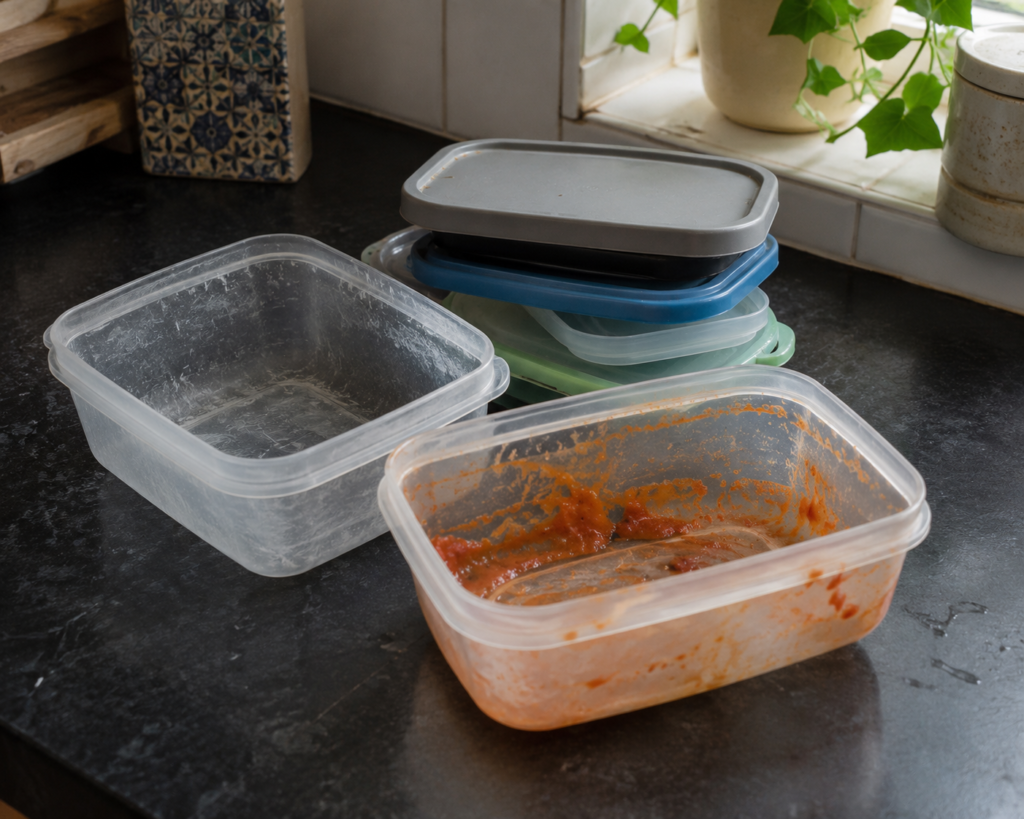
- Storing hot, fatty or acidic food in plastic — think tomato-based sauces, curries, oily leftovers.
- Keeping scratched, cloudy or stained containers in rotation. Damaged plastic sheds more.
If you change nothing else after reading this post, stop microwaving in plastic. Decant onto a plate or into a glass container first. That single habit removes the highest-exposure moment in most kitchens.
The short version: plastic isn’t poison on contact, but heat + fat + worn plastic is the combination to avoid — and the good news is that every alternative below handles all three better.
The best plastic-free food storage options for UK kitchens
Here’s every alternative I’ve actually used, with honest notes on cost, weight, and the annoyances nobody mentions.
Glass containers with locking lids
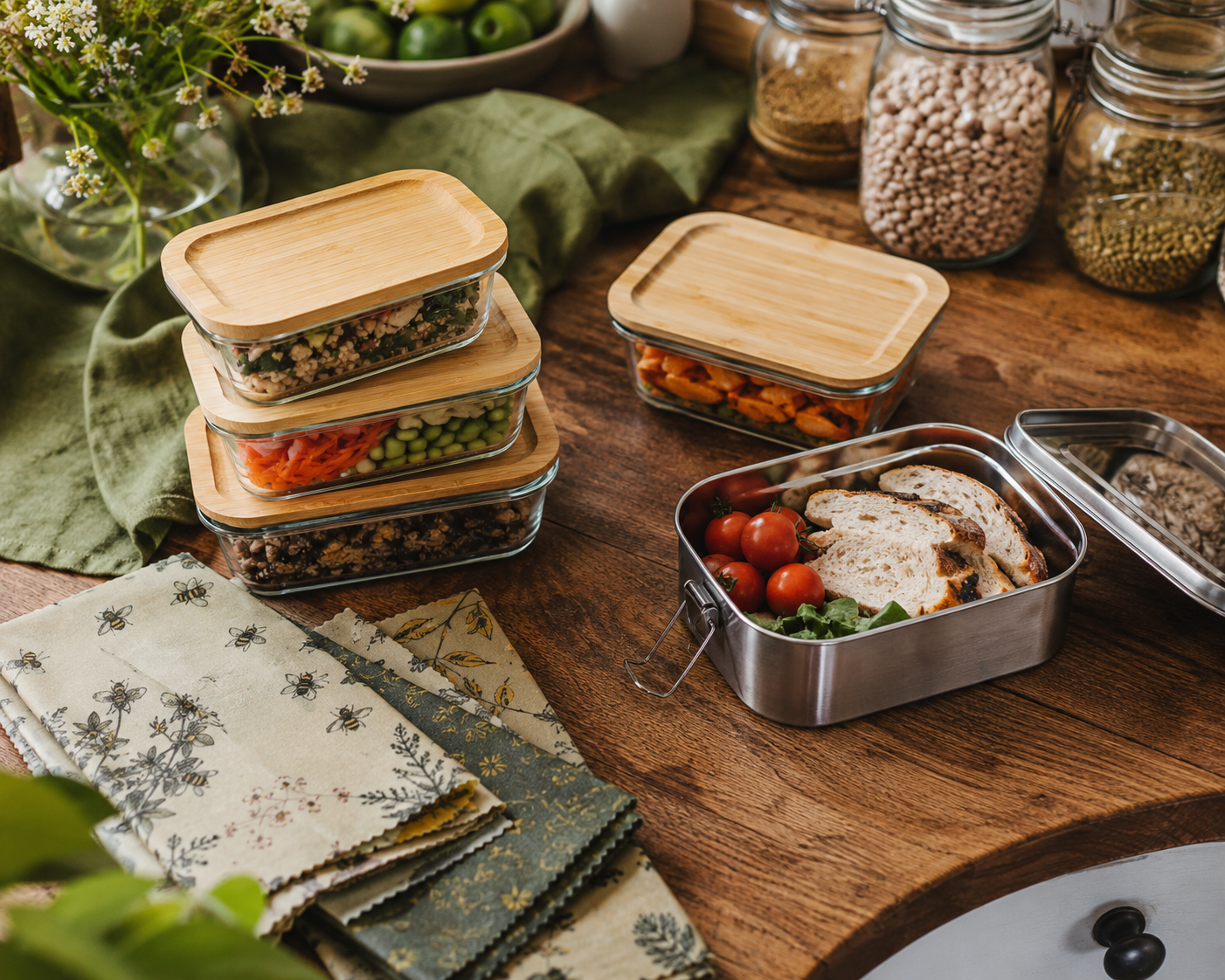
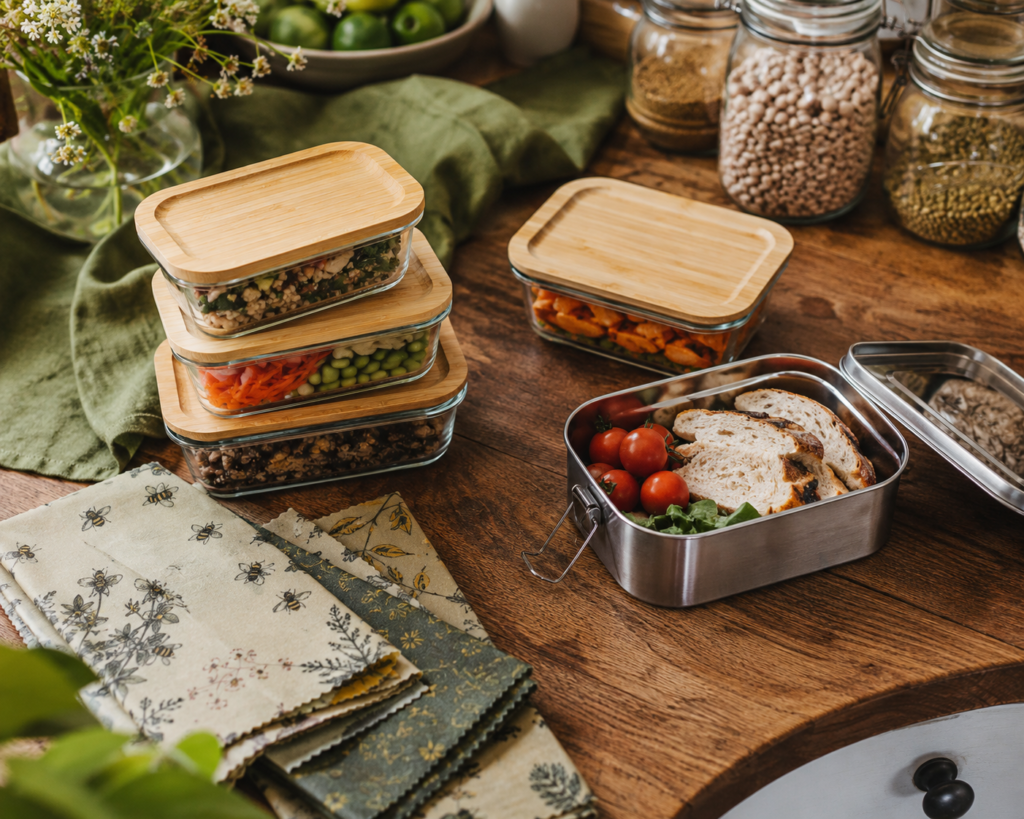
The workhorse. Glass doesn’t stain, doesn’t hold smells, goes from fridge to oven (if borosilicate) and lets you see what’s inside — which genuinely reduces food waste, because leftovers you can see are leftovers you eat.
Watch for: most “glass” containers come with plastic lids. That’s fine — the lid rarely touches the food — but look for lids with silicone rather than rubbery plastic seals, and never microwave with the lid on. Brands like Pyrex are widely available in UK supermarkets, and IKEA’s 365+ range is astonishingly good value. For plastic-free lids entirely, look at glass containers with bamboo lids (Argos, Lakeland and ProCook all stock them).
Honest downside: heavy, and a dropped one on a tiled kitchen floor is a memorable event. Not ideal for children’s lunchboxes.
Budget note: charity shops and car boot sales are full of Pyrex. Some of my best containers cost 50p.
Stainless steel tins and lunchboxes
Brilliant for packed lunches, picnics and anything that travels. Lightweight, unbreakable, and it will outlive you.
Watch for: you can’t microwave it, and you can’t see the contents — label things or you’ll play fridge roulette. Look for food-grade 18/8 stainless steel. Elephant Box (a UK company based in Devon) and A Slice of Green are both excellent, and Lakeland stocks a decent own-range.
Budget note: old-fashioned steel tiffin tins from Asian supermarkets are often half the price of eco-branded equivalents and exactly the same material.
Beeswax wraps
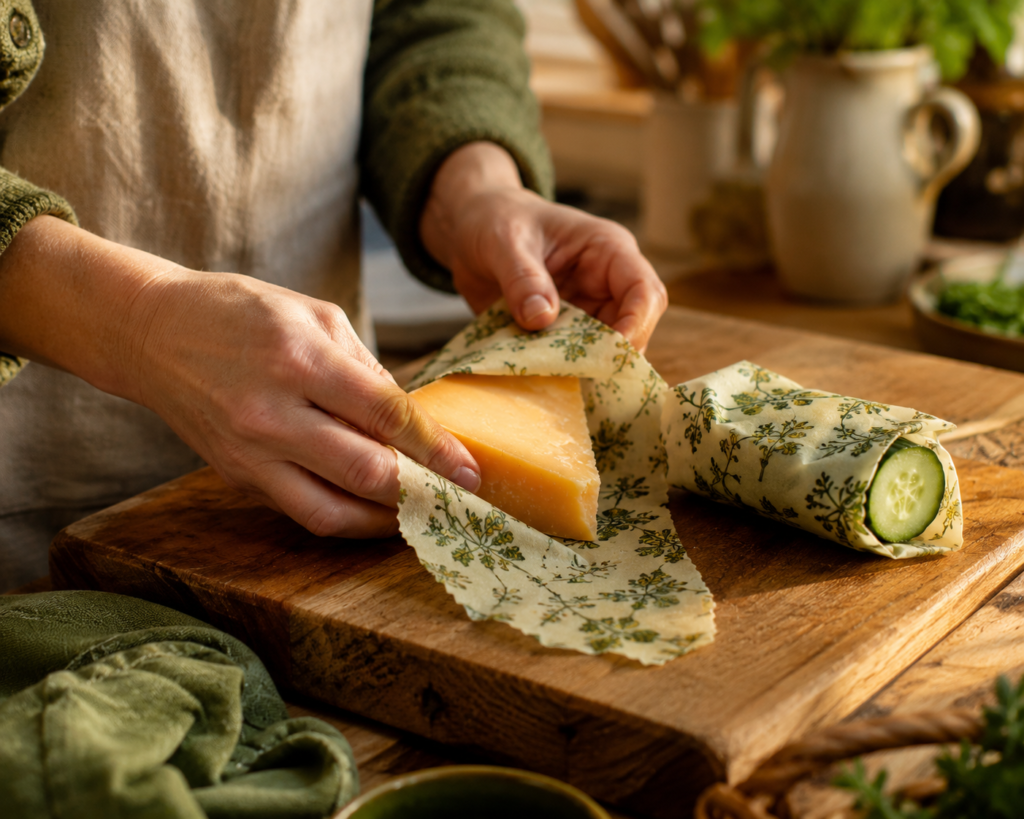
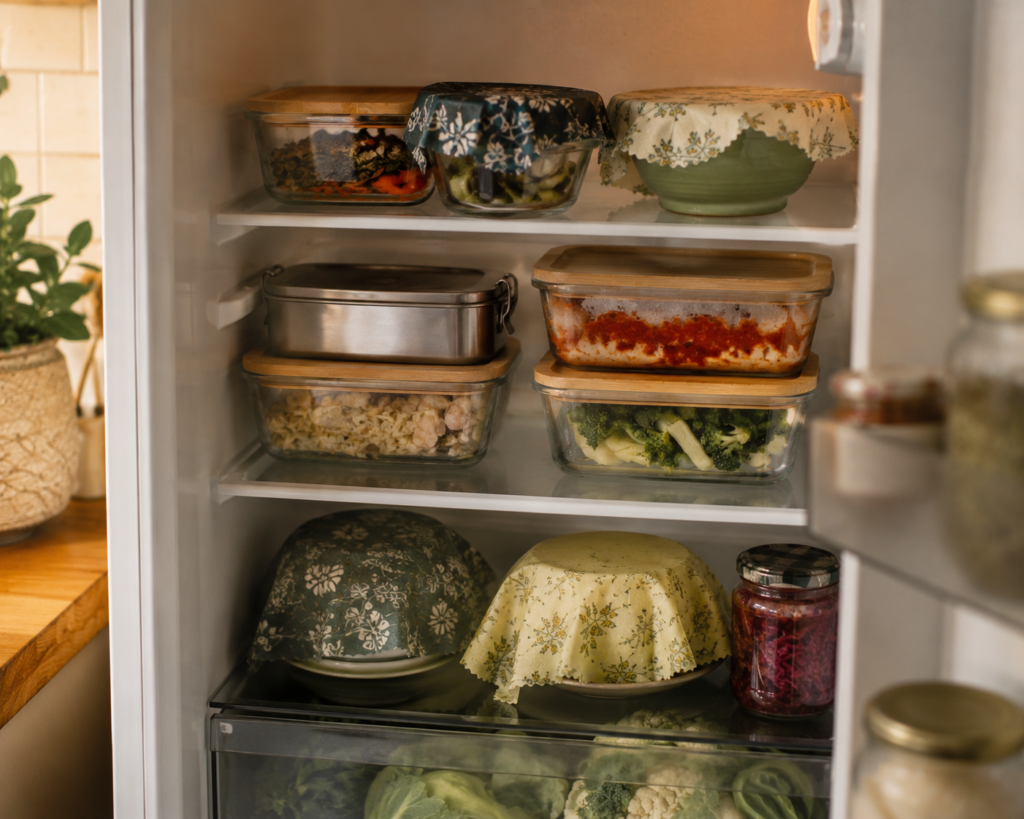
Beeswax wraps are the cling film replacement. A cotton sheet coated in beeswax, jojoba oil and tree resin — you warm it with your hands and it moulds around a bowl, a cheese wedge, or half a cucumber.
Genuinely good for: cheese (it breathes, so cheese keeps better than in cling film), covering bowls, wrapping sandwiches and bread.
Not good for: raw meat or fish (you can’t wash wraps in hot water, so you can’t sanitise them properly). Use a container for those.
UK options: The Beeswax Wrap Co. (made in Gloucestershire) is the gold standard; BeeBee Wraps (Cambridge) is another lovely UK maker. A £12 starter pack replaces roughly a year of cling film, and when they wear out after 12–18 months you can re-wax them or compost them.
Silicone bags and stretch lids
Food-grade silicone occupies a middle ground — it’s not plastic in the conventional sense, and it’s far more stable under heat, but it’s also not a natural material. I use it where nothing else works: freezer bags for soup, batch-cooked sauces and blanched veg.
Watch for: buy 100% platinum-cured food-grade silicone (Stasher is the best-known brand, available at John Lewis and Ocado). Cheap silicone can be bulked out with fillers — pinch and twist it; if white shows through, it’s not pure.
Honest downside: the bags are fiddly to dry and the upfront cost stings (£10–20 per bag). Buy one, see if it suits your cooking, then expand.
Things you already own
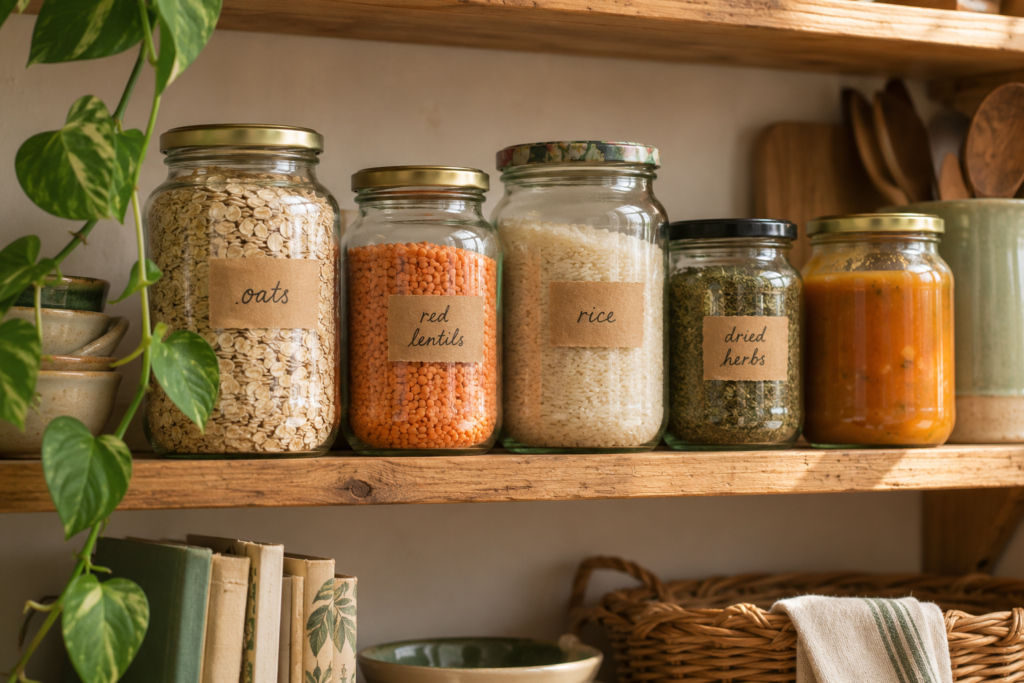
Before buying anything: jam jars, honey jars, and any glass jar with a decent lid are free food storage. They freeze surprisingly well (leave 2–3cm headroom and cool the contents first), they’re perfect for dry goods, leftovers, salad dressings and packed overnight oats. A plate over a bowl covers leftovers in the fridge exactly as well as cling film ever did — it’s what our grandparents did, and they were right.
The short version: glass for the fridge and reheating, steel for anything that travels, wax wraps for cheese and covering, silicone for the freezer, and jam jars for everything else.
What to do with the plastic you already have
This is the part most articles skip, and it matters: do not bin your plastic containers and replace everything at once. That’s neither sustainable nor affordable, and the most eco-friendly container is almost always the one you already own.
Instead, demote rather than dispose:
- Keep good-condition plastic for cold, dry, non-fatty jobs — craft supplies, screws in the shed, dry pasta, freezer organisation (frozen food at -18°C is a very low leaching risk).
- Retire scratched, stained or cloudy containers from food duty entirely. They can still hold pegs, seeds (see our seed-saving guide), or garden twine for years.
- Recycle only what your council actually accepts — check your local authority’s list, because rigid plastics vary wildly by postcode.
- Replace one category at a time as things wear out: reheating containers first (highest exposure), then lunchboxes, then freezer storage last.
The short version: the goal is to stop putting hot, oily food in old plastic — not to create a skip full of landfill in the name of eco living.
A realistic UK shopping list, by budget
Under £15: a Beeswax Wrap Co. starter pack, plus every jam jar you can rescue. This alone eliminates cling film and covers most fridge storage.
Around £40: add a set of glass containers (IKEA 365+ or supermarket Pyrex) for leftovers and reheating, and one stainless steel lunchbox.
Around £80: add two or three silicone freezer bags and a set of glass jars with clip lids (Kilner, made in Liverpool since 1842, widely available) for batch cooking and preserving — which ties in nicely if you’re preserving a garden glut.
You do not need the £200 colour-coordinated set from Instagram. Nobody’s fridge looks like that on a Wednesday.
Frequently asked questions
Is it safe to freeze food in glass? Yes, with two rules: leave headroom for expansion, and never move glass straight from freezer to hot oven — the thermal shock can crack it. Let it stand at room temperature first.
Are plastic lids on glass containers a problem? Minimal. The lid rarely contacts the food, and it’s never in the microwave (take it off). If it bothers you, bamboo-lidded versions exist, but I wouldn’t replace working containers over it.
What about cling film alternatives for raw meat? Use a lidded glass or steel container on the bottom shelf of the fridge. Wax wraps aren’t suitable for raw meat because they can’t be hot-washed.
Is “BPA-free” plastic okay? Better than nothing, but the replacement chemicals aren’t well studied and some look similarly problematic. Treat BPA-free plastic with the same rules: no heat, no fat, no acid, retire it when scratched.
The bottom line
Moving away from plastic food storage isn’t a haul, a lifestyle or an aesthetic — it’s a handful of habits: stop microwaving in plastic today, demote worn containers to non-food jobs, and replace things with glass, steel or cloth as they wear out, one category at a time. Start with a £12 pack of beeswax wraps and the jam jars already in your recycling box, and you’re most of the way there.
Next in this series: Non-toxic cookware UK: what to look for and what to avoid — because what you cook in matters just as much as what you store in.
Written by Nikki Piggott. I’ve been slowly de-plasticising my own UK kitchen since 2023 — every product mentioned here is something I’ve used, bought with my own money, or found in a charity shop. Some links may be affiliate links, which support the blog at no cost to you; they never influence what I recommend.