What’s Actually in Your Household Cleaning Products (A Label-Reading Guide)
As an Amazon Associate I earn from qualifying purchases and sometimes recommend products from other sellers at no extra cost you. For more details see my disclosure policy and privacy policy.
I used to assume that if a cleaning product was on a supermarket shelf, someone — a regulator, a scientist, somebody — had made sure it was safe. It took me an embarrassingly long time to realise that “safe enough to sell” and “safe to spray around your kitchen every day for thirty years” are not the same thing.
I’m not here to scare you. Most household cleaning products won’t cause you immediate harm. But some of the ingredients that show up routinely on their labels are worth knowing about — because once you know what you’re looking at, you can make more informed choices. And in many cases, the alternatives are cheaper anyway.
This guide is for anyone who has ever flipped a bottle of washing-up liquid over, scanned a wall of unpronounceable words, and put it back down again. We’re going to work through the most common ingredients you’ll encounter, what they actually do, and which ones have raised enough questions to be worth switching out.
Why cleaning product labels are so hard to read
Here’s something most people don’t realise: until relatively recently, UK cleaning product manufacturers were not required to list every ingredient on the label. The EU Detergents Regulation (which still largely applies in the UK post-Brexit via retained law) requires disclosure of preservatives, enzymes, fragrances, and disinfecting agents — but “other ingredients” can legally be listed as a catch-all category. Some brands go further and publish full ingredient lists voluntarily. Many don’t.
Free download
Get the Non‑Toxic Home Audit Checklist
A room‑by‑room checklist to help you spot what’s worth swapping in your home — and what’s not worth worrying about. Join the fortnightly newsletter and it’s yours.
No spam, unsubscribe any time.
This matters because the chemicals doing the most work in a cleaning product — and the ones most likely to cause irritation or longer-term concern — are often in that unlisted portion.
The good news: brands are under increasing pressure to be more transparent, partly thanks to the EU Green Claims Directive and the UK CMA’s crackdown on greenwashing. If a brand makes environmental or safety claims on the packaging, they now need to back them up. This is slowly changing what ends up on labels.
For now, though, you need to know what to look for in what is listed.
The ingredient categories you’ll actually encounter
Surfactants
Surfactants are the workhorses of almost every cleaning product. They’re what breaks the bond between grease and water, lifting dirt off surfaces and into the rinse. Without them, cleaning products wouldn’t work.
The question isn’t whether your cleaner contains surfactants — it almost certainly does — but which ones.
Sodium lauryl sulphate (SLS) and sodium laureth sulphate (SLES) are the most common. They’re very effective, inexpensive, and also the most likely to cause skin irritation, particularly with frequent contact. If you’re getting dry hands from washing up or cleaning, SLS is usually a prime suspect. SLES is a milder derivative, but some people still react to it.
Cocamidopropyl betaine is a surfactant derived from coconut oil, often marketed as a gentler alternative. It’s true that it’s generally milder on skin — but it’s also been identified as a common allergen in people with contact dermatitis, so “natural-derived” doesn’t automatically mean “problem-free.”
Alkyl polyglucosides (APGs) are considered one of the more benign surfactant options — derived from plant sugars, readily biodegradable, and with a lower irritation profile. Brands like Ecover and Faith in Nature use these as their primary surfactant, which is worth knowing if you’re looking to switch.
What to do: If you have sensitive skin or clean frequently without gloves, look for products using APG-based surfactants and avoid SLS-heavy formulas. The trade-off is usually some loss of “squeaky clean” foam — but that foam is largely cosmetic anyway.
Preservatives
Cleaning products contain water, which means without preservatives they’d grow mould and bacteria surprisingly quickly. Preservatives are necessary — but some are more troubling than others.
Methylisothiazolinone (MIT) and methylchloroisothiazolinone (CMIT) are among the most widely used preservatives in rinse-off and leave-on cleaning products. They’re effective in very small quantities. They’re also among the most common causes of contact allergy in Europe. The EU restricted MIT concentrations in leave-on products in 2017 after a surge in allergic reactions, and the Scientific Committee on Consumer Safety has since stated there’s no safe concentration for leave-on products. They remain permitted in rinse-off products at low levels.
You’ll find these on labels as MIT, CMIT, Kathon CG, or Neolone. They’re common in multi-surface sprays, washing-up liquids, and floor cleaners.
Benzisothiazolinone (BIT) is less well-known but in the same family. It’s often used in industrial cleaning products that cross over to household use.
Bronopol (2-bromo-2-nitropropane-1,3-diol) can release small amounts of formaldehyde over time, particularly when in contact with certain amines. It’s less common in cleaning products than in cosmetics, but worth recognising.
Safer alternatives: Some brands use sodium benzoate (a simple, well-understood preservative derived from benzoic acid) or tocopherol (vitamin E) as a preservative. Concentrated products that require dilution before use often need fewer preservatives because the water content is added by you at home.
Fragrances
The word “fragrance” or “parfum” on an ingredient list is hiding a lot. Under current EU and UK regulations, fragrance is classified as a trade secret — meaning a brand can list a single word to cover a blend of potentially dozens of individual compounds, without disclosing what those compounds are.
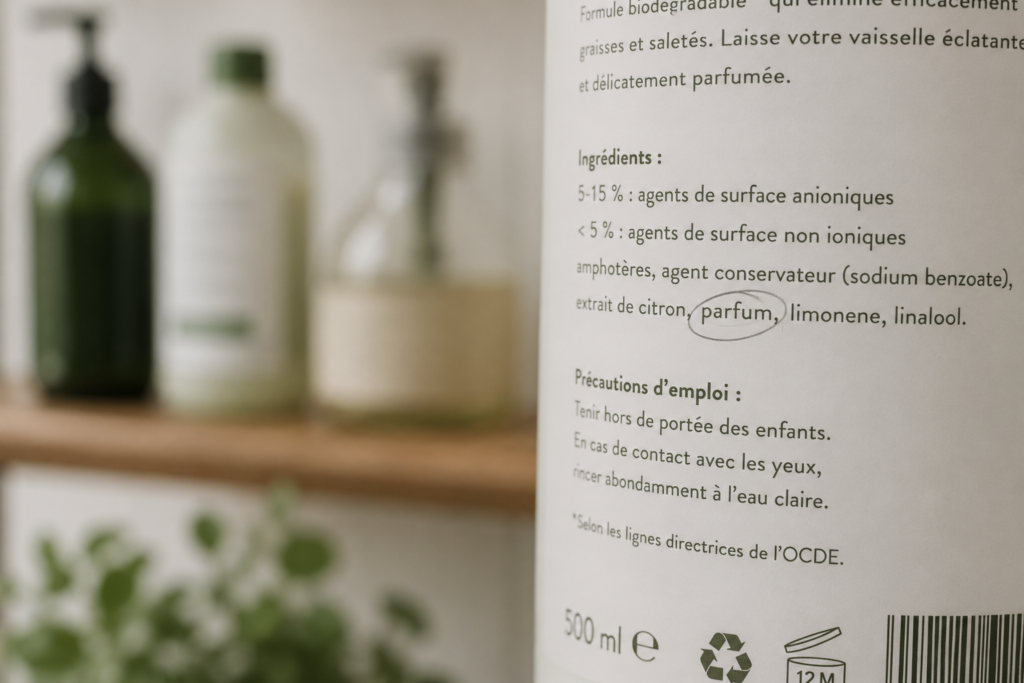
Some fragrance chemicals are sensitisers — meaning they can trigger allergic reactions, particularly in people with asthma or eczema. A handful are under regulatory review for potential endocrine-disrupting properties, though evidence in humans at typical exposure levels is still debated.
The ones most commonly flagged by dermatologists and toxicologists include linalool, limonene, citronellol, and geraniol — all naturally occurring in essential oils, all listed as potential allergens in the EU Cosmetics Regulation. They’re not banned; they’re just required to be disclosed when present above a certain concentration.
Synthetic musks — particularly nitromusks like galaxolide and tonalide — are used widely in cleaning products for their long-lasting scent. They’re poorly biodegradable, accumulate in aquatic organisms, and have been found in human blood and breast milk. Regulatory pressure is gradually phasing some of them out, but they’re still in widespread use.
What to do: “Fragrance-free” is not the same as “unscented.” An unscented product may still contain fragrance chemicals to mask the smell of other ingredients. Look for “fragrance-free” or products that list individual essential oils rather than “parfum.” Better still, choose products with no added fragrance at all — most surfaces don’t need to smell of anything once rinsed.
Disinfectants and antimicrobials
The pandemic drove a surge in disinfectant use, and many households have kept the habit going. It’s worth understanding what’s in these products — because the strongest ones come with their own trade-offs.
Quaternary ammonium compounds (quats) — such as benzalkonium chloride (BAK), didecyldimethylammonium chloride (DDAC), and cetrimonium chloride — are the active disinfectants in most antibacterial sprays, wet wipes, and “hospital grade” cleaners. They’re effective against a wide range of pathogens. They’re also significant skin and respiratory irritants, and research has raised concerns about their role in promoting antibiotic resistance in bacteria.
For most household surfaces, they’re overkill. NHS guidance doesn’t recommend routine antibacterial cleaning in healthy homes — ordinary detergent and hot water removes the vast majority of harmful bacteria on kitchen surfaces just as effectively as a disinfectant spray.
Bleach (sodium hypochlorite) is effective, cheap, and well-understood. The main issues are respiratory irritation (don’t use in an unventilated space), skin irritation, and the production of chlorinated compounds when it reacts with organic matter. It should never be mixed with anything acidic (including vinegar) or with ammonia.
Hydrogen peroxide is used in some “oxygen bleach” cleaning products and is generally considered a more environmentally benign alternative to chlorine bleach — it breaks down into water and oxygen. It’s effective as a disinfectant at concentrations above 3%, though most household products use lower concentrations.
What to do: For routine kitchen and bathroom cleaning in a healthy household, you don’t need a disinfectant product. Save the quats and bleach for situations where they’re genuinely warranted — someone has been ill, there’s been a raw meat spillage, or you’re cleaning a space where infection risk is elevated.
Optical brighteners
You’ll find these in laundry products more than in surface cleaners, but they’re worth knowing about. Optical brighteners (also called fluorescent whitening agents or FWAs) don’t actually clean anything — they coat fabric fibres with compounds that absorb UV light and re-emit it as blue-white light, making whites look brighter to the eye.
They’re poorly biodegradable and can accumulate in aquatic environments. Some people with sensitive skin react to them remaining on clothing after washing. They serve no cleaning function whatsoever.
Chelating agents and builders
These ingredients help cleaning products work in hard water by binding to calcium and magnesium ions that would otherwise interfere with surfactants. Most of the UK has hard or very hard water, so these matter.
EDTA (ethylenediaminetetraacetic acid) is the most common chelating agent. It works well but is very poorly biodegradable — it persists in waterways and can mobilise heavy metals from sediment.
Phosphates (such as sodium tripolyphosphate, STPP) were the standard builder in older laundry products but have been heavily restricted in the EU and UK due to their role in causing algal blooms in waterways. Most major brands phased them out in washing powders and dishwasher tablets over the last decade. Worth checking on cheaper imported products.
Better alternatives: Citric acid is an effective, biodegradable water softener used in many eco cleaning products. Sodium gluconate is another biodegradable chelating agent increasingly used as a phosphate and EDTA replacement.
A practical label-reading approach
You don’t need to memorise every chemical name. Here’s a simpler framework:
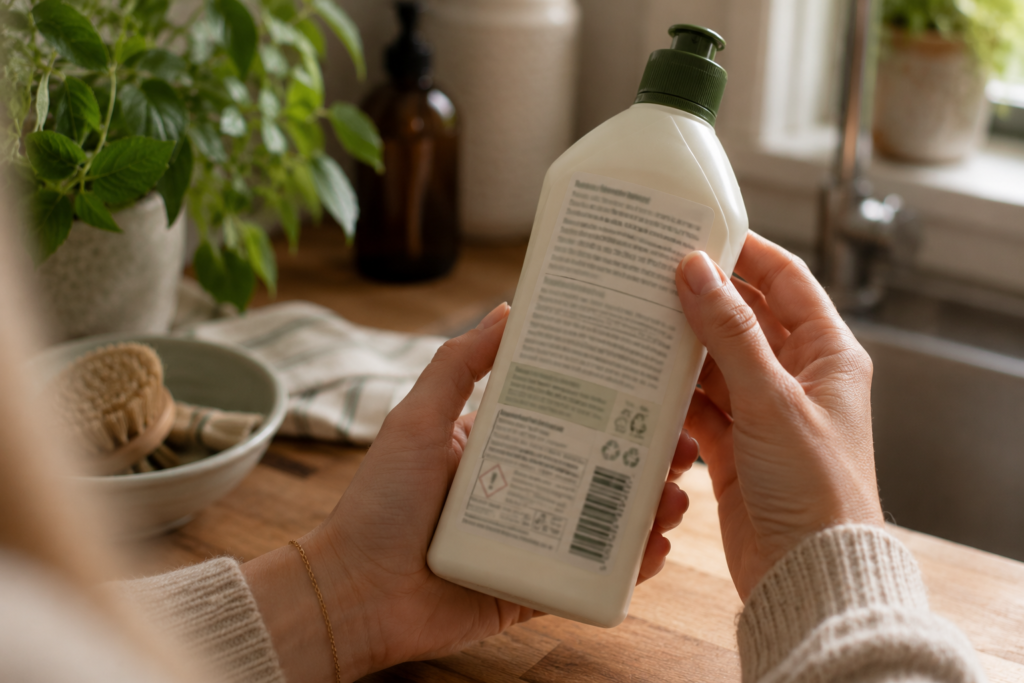
Look for: APG surfactants, citric acid, sodium bicarbonate (bicarb), sodium percarbonate (oxygen bleach), sodium gluconate, tocopherol or sodium benzoate as preservatives, and individual listed essential oils.
Be more cautious about: SLS in products you use without gloves, MIT/CMIT preservatives (especially in sprays you use in enclosed spaces), “fragrance” or “parfum” without any further disclosure, quats (benzalkonium chloride, DDAC) in everyday surface cleaners, and EDTA.
Worth noting: A product can be full of synthetic chemicals and be relatively safe and biodegradable. A product can be “natural” and still contain significant allergens. The binary isn’t natural vs synthetic — it’s about specific ingredients and how you use them.
The brands I’ve found most transparent (UK)
After spending a lot of time reading labels in supermarket aisles (the staff at my local Waitrose now think I’m slightly unhinged), these are the brands I’ve found most consistent about ingredient disclosure and formulation:
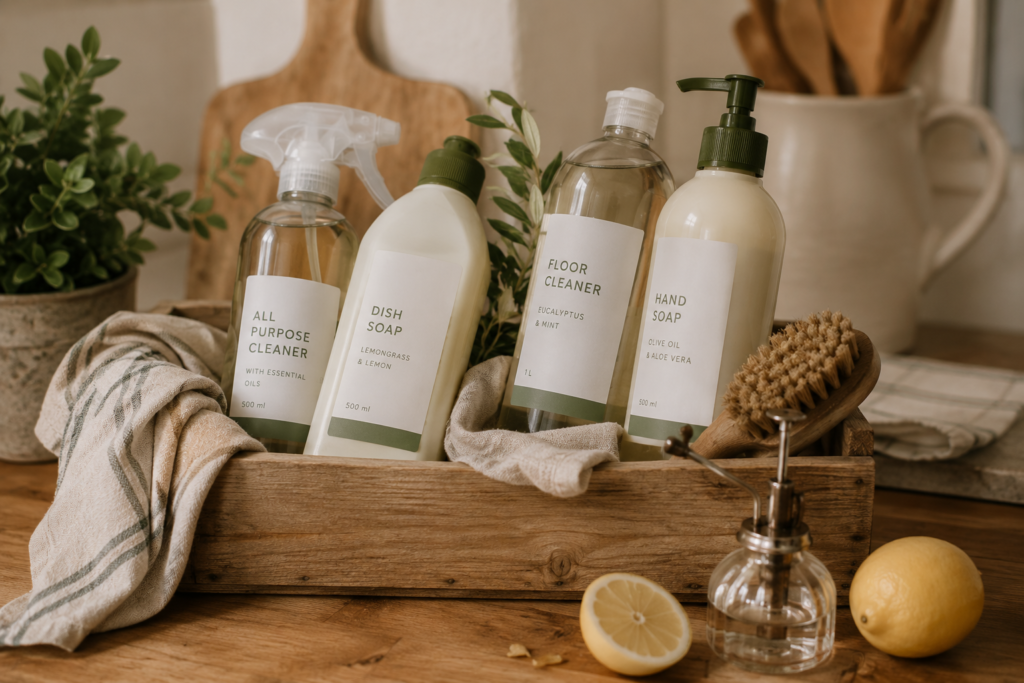
Ecover — full ingredient lists on their website and usually on pack. APG-based surfactants, no optical brighteners in laundry products, EDTA-free. Widely available in UK supermarkets.
Faith in Nature — excellent label transparency, fragrance from listed essential oils rather than “parfum,” no parabens or SLS.
Smol (laundry and dishwasher) — concentrated tablets with a short ingredient list; they publish full formulations online. No optical brighteners, phosphate-free.
Miniml — a UK refill-model brand with full ingredient transparency. Available via their own website and through many zero-waste refill shops.
Method — more transparent than most mainstream brands, though their fragrance disclosure is vaguer than I’d like. Their surfactant base is generally gentler than standard supermarket alternatives.
This isn’t an exhaustive list or a paid recommendation — these are just the brands I’ve been able to actually verify through their own published formulations.
The honest summary
Reading cleaning product labels is frustrating because the system isn’t designed to make it easy. But knowing the rough categories — surfactants, preservatives, fragrances, disinfectants — and having a handful of specific ingredients to watch for gets you most of the way there.
You don’t need to throw everything out and start from scratch. If your current products work and your skin is happy, keep using them up before switching. When you do restock, spend two minutes reading the label before picking based on price or habit. The best cleaning product is one that does the job without any ingredients you’re not comfortable with — and increasingly, those products are just as affordable as the ones you’ve always bought.
If this was useful, the next post in our non-toxic home series goes deeper into specific room-by-room swaps: The Non-Toxic Home Guide: Room-by-Room Swaps for UK Households. You might also like our DIY natural cleaning recipes for the surfaces where a bought product isn’t worth the label anxiety.
Nikki Piggott writes about sustainable and eco-friendly living from her home in the UK. All product mentions reflect her personal experience and research — no sponsored content.