No-Mow May: What It Is, Why It Matters, and What to Do Instead of Mowing
As an Amazon Associate I earn from qualifying purchases and sometimes recommend products from other sellers at no extra cost you. For more details see my disclosure policy and privacy policy.
Every May, my lawn mower stays in the shed. Not because I’ve forgotten about it, or because I’ve run out of time between school runs and work — but because I’ve made a deliberate choice to leave the grass alone for one whole month. And honestly? The garden has never looked more alive for it.
No-Mow May is one of those rare environmental campaigns that asks almost nothing of you and gives an enormous amount back. No purchases required. No specialist knowledge needed. Just a willingness to let go of the idea that a short, striped lawn is the only kind of ‘proper’ garden.
In this post I’m going to explain what No-Mow May actually is (and who started it), why it matters ecologically, and — crucially — what you can do with your outdoor space instead of mowing, so your garden stays purposeful and beautiful throughout the month.
What Is No-Mow May?
No-Mow May is a UK campaign run by the conservation charity Plantlife, asking gardeners to simply stop mowing their lawns for the entire month of May. The idea is straightforward: by allowing grass and wildflowers to grow unchecked for four weeks at the height of spring, you create a surge of nectar and habitat at exactly the moment when pollinators need it most.
Free download
Get the Non‑Toxic Home Audit Checklist
A room‑by‑room checklist to help you spot what’s worth swapping in your home — and what’s not worth worrying about. Join the fortnightly newsletter and it’s yours.
No spam, unsubscribe any time.
Plantlife launched the campaign in 2019 and it has grown substantially since. The 2021 Every Flower Counts survey — where participants counted the flowers in their unmowed lawns — found an average of 175 flowers per square metre in gardens that had been left to grow, compared to almost none in regularly mown grass. That’s not a marginal difference; it’s transformative.
In the UK, May is the critical window. Bumblebee queens are emerging from hibernation and urgently need nectar to start their colonies. Solitary bees are nesting. Butterflies are on the wing. The timing of No-Mow May isn’t arbitrary — it’s designed around the ecological calendar of British wildlife.
Why Does It Matter? The Ecological Case
Britain has lost 97% of its wildflower meadows since the 1930s. That figure is so dramatic it’s almost difficult to process. Intensive agriculture, urban expansion, and yes — millions of well-kept, regularly mown suburban lawns — have all contributed to a collapse in the habitat that native pollinators depend on.
The pollinator problem
The UK is home to around 1,500 species of insect that pollinate plants — including 24 species of bumblebee, over 240 species of solitary bee, and countless moths, hoverflies, and beetles. Many of these are in serious decline. According to the State of Nature Report, 41% of UK species have declined in abundance since 1970.
What pollinators need, above almost everything else, is food — specifically nectar and pollen-rich flowers. The average British lawn, mown to a bowling-green standard every week, offers none of that. But let it grow for a month in May, and dandelions, clover, self-heal, and speedwell will bloom in profusion, providing a genuine nectar source at a critical time.
Dandelions are not weeds
I know. The instinct is to see dandelions as a problem. But a dandelion in full flower in May is one of the single most valuable food sources for early-season bumblebees in the entire British landscape. A lawn scattered with dandelions is not a neglected lawn; it is a functioning micro-habitat.
White clover is similarly valuable — it fixes nitrogen in the soil (meaning a clover-rich lawn actually needs less feeding), it stays green through drought, and it provides nectar accessible to short-tongued bumblebees that can’t reach into deeper flowers. Self-heal, which produces small purple flowers close to the ground, is another lawm wildflower that thrives when mowing stops.
The bigger picture
There are an estimated 23 million gardens in the UK, covering more land than all of our National Nature Reserves combined. If even a fraction of those gardens participate in No-Mow May, the cumulative ecological impact is genuinely significant. This isn’t a symbolic gesture — it’s a meaningful contribution to reversing pollinator decline.
Common Concerns (and Why They’re Worth Pushing Through)
Before I get into the practical alternatives to mowing, I want to address the things that make people hesitant — because I’ve heard them all, and I’ve felt them myself.
“My neighbours will think I’ve given up”
This is real. There’s still a strong social norm in the UK that a tidy garden means a mown lawn. My solution: a small sign. Plantlife produces free No-Mow May signs you can print and display, which signals intention rather than neglect. It reframes the unmowed lawn as a choice, not a failing. You can find them via the Plantlife website.
“Won’t it get out of control?”
In a single month, a lawn will not turn into an impenetrable jungle. Grass grows roughly 2–4cm per week in May, depending on your region and the weather. By the end of the month you’ll have longer grass, likely with patches of flowering plants — but nothing that can’t be easily returned to a shorter length at the start of June. The key is to cut in stages when you do return to mowing: take the height down in two or three cuts over a couple of weeks rather than scalping it immediately.
“I have children / pets who use the lawn”
You don’t have to apply No-Mow May to every inch of your garden. Even leaving a third or half of your lawn unmowed has real benefits. Many gardens find a natural solution: mow the area closest to the house or the regular play area, and leave the edges or back of the garden to grow. The wildlife corridor you create — even a narrow strip — is genuinely useful.
What to Do Instead of Mowing: 8 Practical Ideas
If your mower is staying in the shed, May is actually a brilliant month to redirect that energy into other garden tasks — things that will pay off all year and that work beautifully alongside a wilder lawn aesthetic.
1. Edge your paths and borders
A garden with longer grass looks intentional rather than forgotten if the edges are clean. Spend the time you’d normally use mowing on edging instead: trim the boundary between lawn and border sharply, and your long grass will look like a design choice rather than an oversight. A half-moon edger or long-handled edging shears are the tools for this job.
2. Add a wildflower patch
May is the perfect time to prepare a dedicated wildflower area — an area of your garden that you’re committing to wilder management permanently, not just for the month. Scrape back a patch of lawn to bare soil (grass suppresses wildflower germination), scatter a native wildflower seed mix, and firm it down. You won’t see results until later in the summer, but you’ll be setting up an ongoing wildlife resource. RHS-approved native seed mixes from suppliers like Pictorial Meadows or Naturescape are a good starting point.
3. Build a bug hotel
A longer lawn is better habitat; a bug hotel gives solitary bees and beetles somewhere to nest and overwinter. You can make one for free using hollow stems (bamboo canes, old buddleia stems, hogweed), stacked logs with holes drilled in, pine cones, and dry leaves. Position it facing south-east if possible, at least 30cm off the ground, and in a sheltered spot. The RSPB has excellent free guidance on construction.
4. Install a hedgehog highway
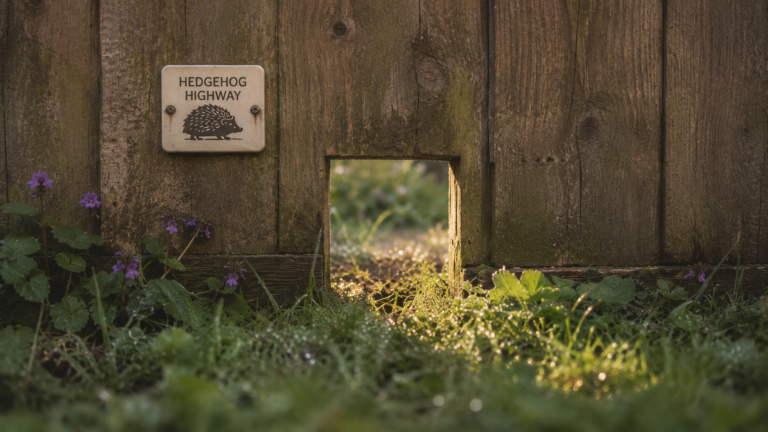
A 13x13cm hole at the base of your garden fence connects your garden to your neighbours’ and gives hedgehogs — whose numbers have halved in the UK since 2000 — the movement they need to find food and mates. Chat to your neighbours first, mark the spot, and use a jigsaw or handsaw to cut the opening. Hedgehog Street, run by the British Hedgehog Preservation Society and the PTES, has free downloadable templates and signage.
5. Tend your vegetable patch
May is one of the busiest vegetable gardening months in the UK: direct-sowing courgettes, beans, and squash outdoors once frost risk passes; potting on tomatoes; planting out brassica seedlings. All of that takes time and attention — which you now have, because your mower is in the shed. Redirecting lawn-care hours into food growing is one of the most satisfying trades you can make.
6. Add a water source for wildlife
A shallow dish of water — even an upturned bin lid — placed on the ground gives birds, hedgehogs, and insects somewhere to drink and bathe. Top it up daily and add a stone or gravel ramp so smaller creatures can climb out. A longer lawn already provides food and shelter; water completes the habitat trifecta.
7. Plant native hedging
If you’ve been thinking about replacing a fence with living hedge, May is a good time to plan it even if you plant in autumn. Research native hedging mixes (hawthorn, blackthorn, dog rose, field maple, and guelder rose are all excellent UK choices), measure your boundary, and order bare-root plants from a nursery now for autumn planting. Native hedging provides nesting habitat, fruit for birds, and nectar — and is generally cheaper to install than fencing.
8. Compost
May produces a surplus of green material from borders and veg plot thinnings. Turn your compost heap, add material in layers (green and brown, alternating), and water if it’s dry. A functioning compost heap is one of the genuinely free inputs to a productive garden, and it takes surprisingly little time to manage well.
What Happens When June Arrives?
When No-Mow May ends, the grass doesn’t have to go back to a bowling green. Many gardeners find that a month of letting go creates a new relationship with their lawn — one that involves a little more tolerance for clover and daisies, and a little less anxiety about uniformity.
Plantlife also runs a ‘Keep it and See’ challenge encouraging gardeners to adopt a more relaxed mowing approach throughout the summer — mowing less frequently, cutting to a higher height, and maintaining permanent unmowed areas. The evidence suggests this is better for wildlife than a one-month surge followed by a return to intensive management.
If you do want to return to shorter grass in June, do it gradually. Set your mower to its highest setting for the first cut, then work down over two or three weeks. This minimises the shock to the grass and gives any insects still using the lawn time to move on.
The Bigger Picture: Your Lawn as a Living System
No-Mow May is an easy entry point into a wider shift in how we think about our gardens. The traditional British lawn — short, striped, weed-free — is a relatively recent cultural invention, and not a particularly ecological one. A lawn managed with wildlife in mind — lower mowing frequency, higher cutting height, tolerance for ‘weeds’ that are actually native wildflowers — can be just as beautiful and far more alive.
I’ve written elsewhere on Daya Tree about rewilding your UK garden more broadly — including native plant choices, wildlife ponds, and log pile habitats. No-Mow May sits within that wider project of making our outdoor spaces genuinely useful to the natural world, without demanding that we sacrifice a garden we love.
Progress over perfection. A dandelion in your lawn is not a failure. It’s a bumblebee’s breakfast.
The Complete Guide to Rewilding Your UK Garden (2026 / How to Turn Your UK Garden into a Wildlife Habitat / Wildlife Pond in a Small Garden: How to Do It Affordably