DIY Natural Cleaning Recipes That Actually Work: Surfaces, Glass, and Bathrooms
As an Amazon Associate I earn from qualifying purchases and sometimes recommend products from other sellers at no extra cost you. For more details see my disclosure policy and privacy policy.
I’ll be honest with you: I was sceptical. When I first started looking into natural cleaning recipes, most of what I found was either vague (“try white vinegar!”) or wildly optimistic about what bicarbonate of soda can actually achieve. So I spent several months testing recipes on my own kitchen, bathroom, and windows — a Victorian terrace with hard water, limescale on everything, and a bathroom grouted in a shade I’ve come to call “previous-owner grey.”
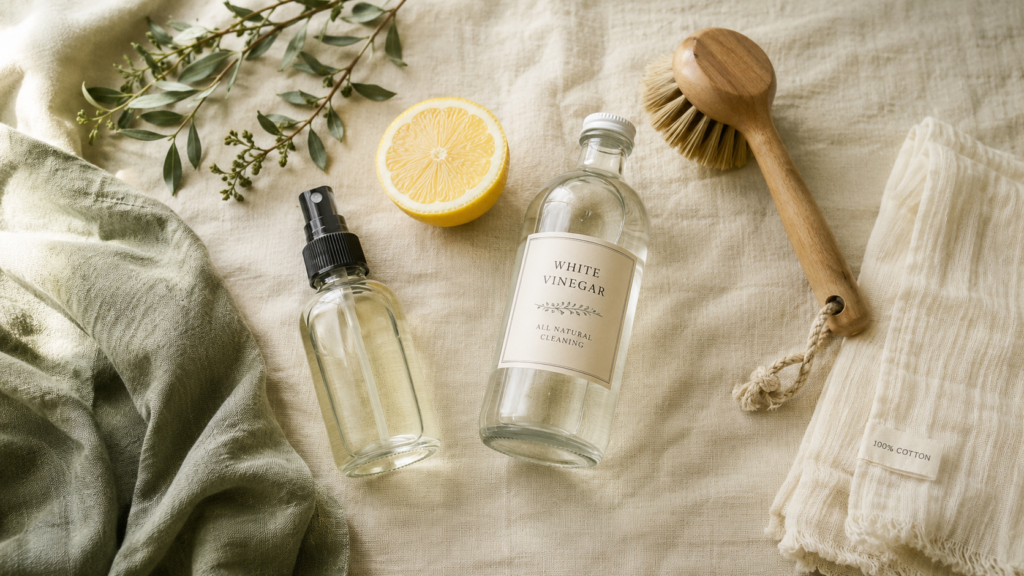
What follows is what actually worked. Not what should work in theory. Not what worked in someone else’s gleaming new kitchen. What worked in mine — and what didn’t, which is equally worth knowing.
Why bother with natural cleaning products?
Conventional cleaning sprays often contain synthetic fragrances, surfactants derived from petrochemicals, and preservatives that don’t biodegrade cleanly. Many are also packaged in single-use plastic. The impact isn’t dramatic — your kitchen spray isn’t going to make you ill — but it adds up across a household over years, both environmentally and in terms of what you’re breathing in regularly.
Natural alternatives, made from a short list of ingredients most UK households already have, can replace the majority of commercial sprays. They’re cheaper, they’re refillable, and you know exactly what’s in them. The trade-off is that some tasks take a bit more effort — I’ll be clear about where that’s the case.
Free download
Get the Non‑Toxic Home Audit Checklist
A room‑by‑room checklist to help you spot what’s worth swapping in your home — and what’s not worth worrying about. Join the fortnightly newsletter and it’s yours.
No spam, unsubscribe any time.
The four ingredients that do most of the work
Before we get to recipes, it helps to understand what each ingredient actually does. This will stop you mixing things that cancel each other out (looking at you, vinegar + bicarbonate enthusiasts).
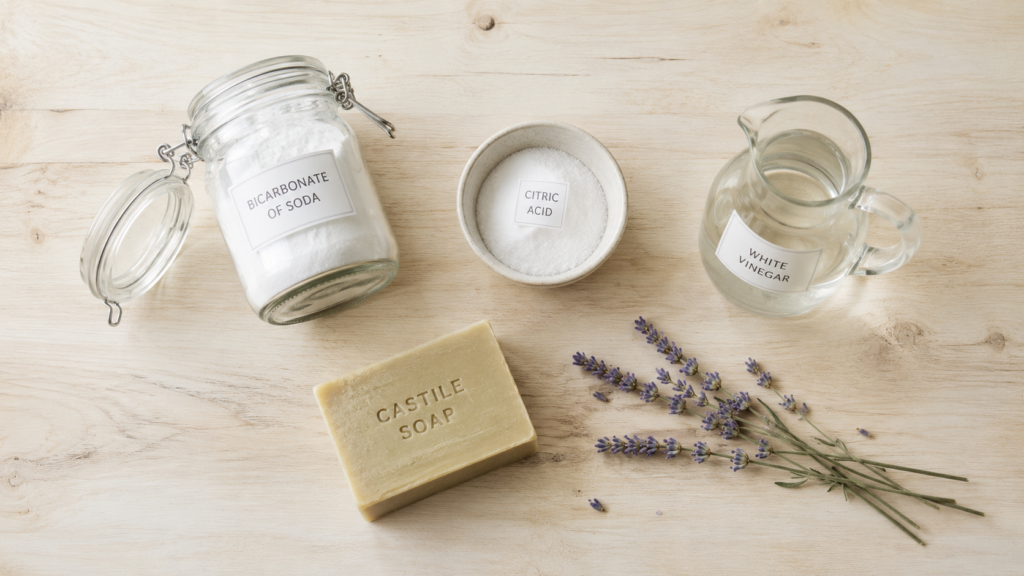
- White vinegar (5% acidity) — acidic, so it dissolves limescale, mineral deposits, and soap scum. Effective on glass. Does not disinfect (despite what many sites claim). Do not use on natural stone, marble, or unsealed grout.
- Bicarbonate of soda (baking soda) — mildly abrasive and alkaline. Good for scrubbing and deodorising. Works well dry or as a paste. When mixed with vinegar, it neutralises both — producing a brief fizz and then essentially water. Don’t combine them hoping to get both effects.
- Castile soap (liquid) — plant-based soap concentrate. Cuts grease effectively. A small amount goes a long way. Avoid mixing with vinegar — the acid “unsaponifies” the soap, leaving a greasy residue.
- Washing soda (sodium carbonate) — stronger than bicarbonate, more alkaline. Good for heavy grease, blocked drains, and laundry. Available from hardware shops and some UK supermarkets (Dri-Pak is the most common brand). Wear gloves — it can irritate skin.
A note on essential oils: Tea tree oil has weak antimicrobial properties at sufficient concentrations. Lavender smells nice. Neither is a substitute for a proper disinfectant in situations where you actually need one (after handling raw meat, for example). I use them for scent, not hygiene claims.
Kitchen surfaces
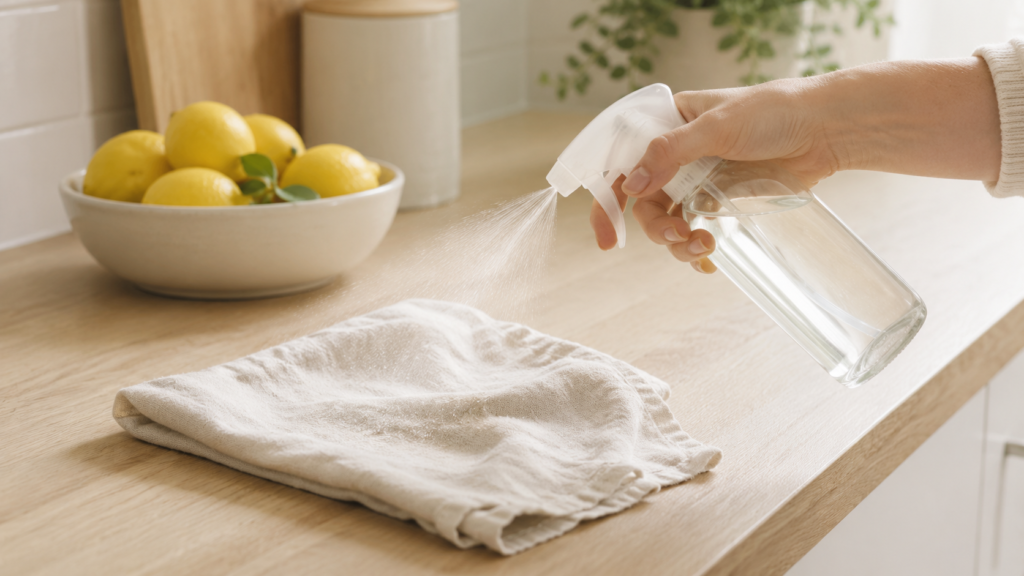
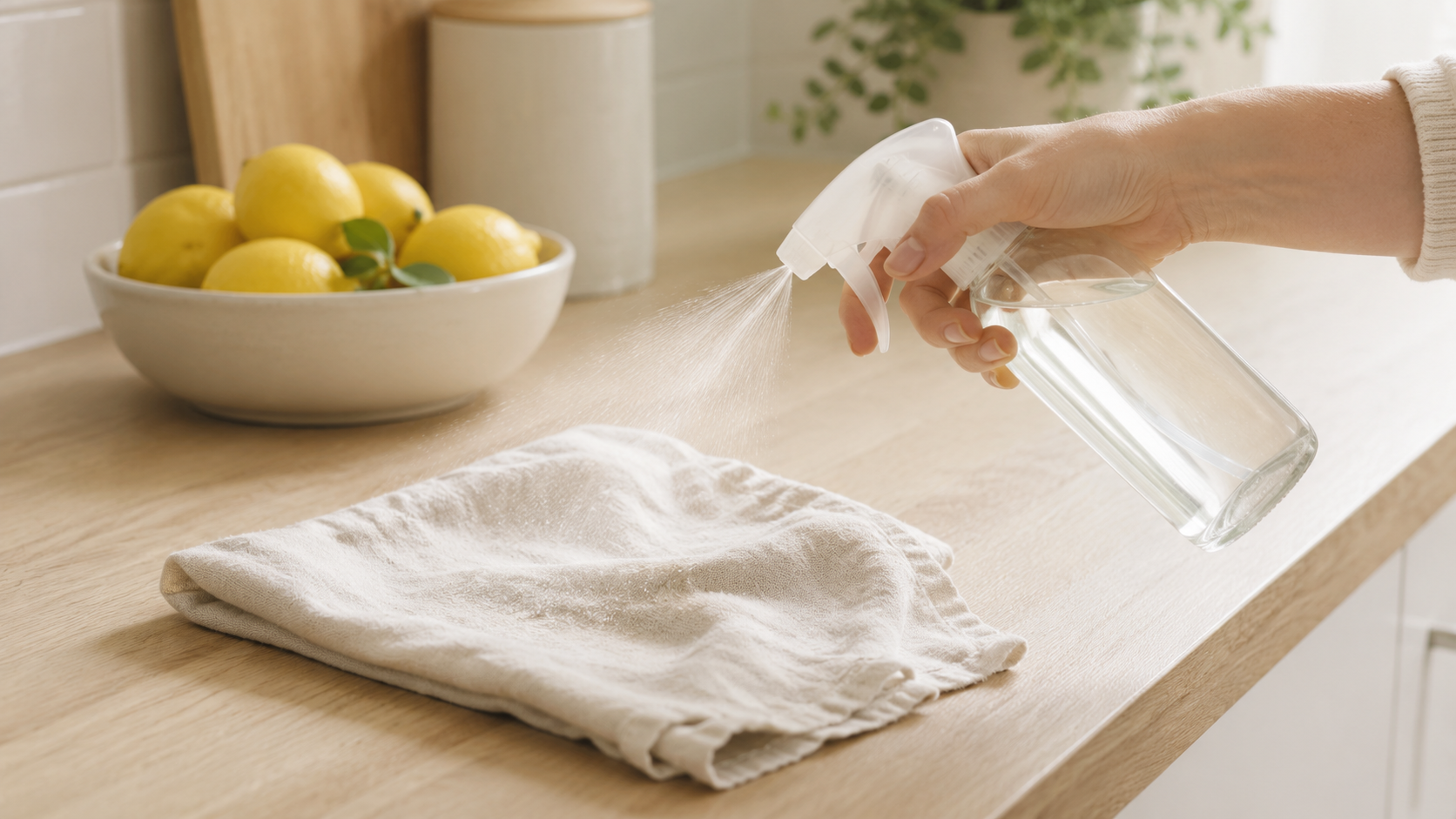
Everyday kitchen spray
This is the one I reach for daily — worktops, hob surrounds, appliance exteriors, sink surrounds. It handles light grease and general grime well. I’ve been using it for over a year and it’s replaced three different commercial sprays.
You’ll need:
- 500ml water
- 1 tbsp liquid castile soap
- 1 tbsp white vinegar
- 10 drops tea tree essential oil (optional)
- Reusable spray bottle
Method:
- Add the castile soap to the bottle first.
- Add the vinegar.
- Top up with water — pour slowly to avoid foam.
- Add essential oil if using. Shake gently.
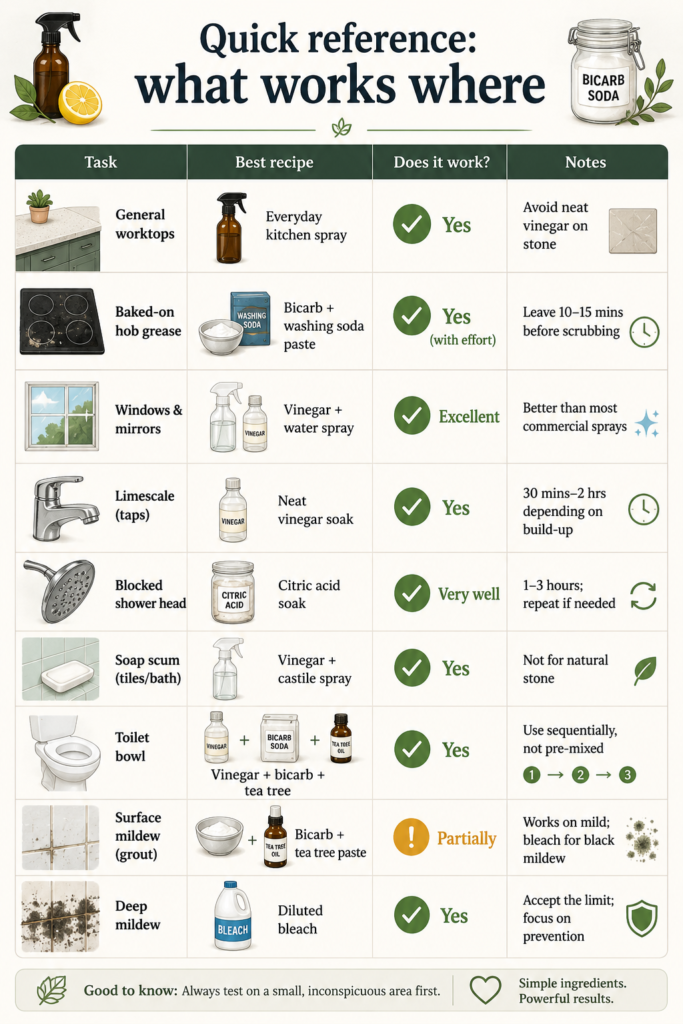
Does it work? Yes, reliably well on laminate and tile. On natural wood worktops, I wipe over with a damp cloth rather than spraying directly — the vinegar is fine diluted like this, but I wouldn’t soak unsealed wood.
Heavy-duty degreaser (hob and oven exterior)
For baked-on grease and sticky hob marks, the standard spray doesn’t cut it. This paste recipe is what actually shifted the ring around my gas burners that had been there since I moved in.
You’ll need:
- 4 tbsp bicarbonate of soda
- 1 tbsp washing soda
- 1–2 tsp castile soap
- Enough water to make a thick paste
Method:
- Mix dry ingredients together.
- Add castile soap and stir.
- Add water a little at a time until you have a spreadable paste.
- Apply to the surface, leave for 10–15 minutes, then scrub with a stiff brush and rinse.
Does it work? Yes, better than I expected. The washing soda does the heavy lifting on grease. This is not a quick-wipe solution — you need to leave it to work and then put in a bit of scrubbing effort — but the results are comparable to commercial oven cleaner on greasy hob surfaces. Don’t use on aluminium or non-stick coatings.
Glass and mirrors
Glass is where natural cleaning genuinely outperforms most commercial sprays. The reason shop-bought glass cleaners often leave streaks is that they contain surfactants that are good at lifting dirt but hard to rinse completely from a non-porous surface. Diluted white vinegar — which contains no surfactants — leaves glass cleaner and streak-free, every time.
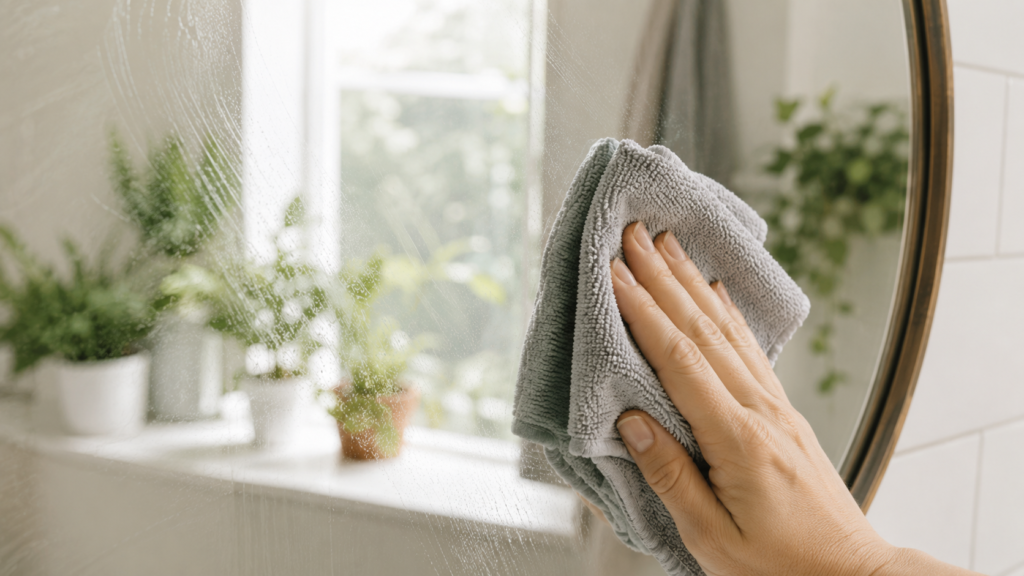
Streak-free glass and mirror spray
You’ll need:
- 250ml white vinegar
- 250ml water
- Reusable spray bottle
- Microfibre cloth (this matters — lint-free is the key to streak-free)
Method:
- Mix vinegar and water in the spray bottle.
- Spray directly onto the glass or mirror.
- Wipe in circular motions with a dry microfibre cloth. Buff until clear.
Does it work? This is the one where natural cleaning wins outright. I’ve used it on bathroom mirrors, kitchen windows, and full-length mirrors. No streaks, even on large surfaces. The slight vinegar smell disappears completely once dry — within a minute or two. If you have a lot of soap residue build-up on shower glass, increase to a 1:1 ratio or apply neat vinegar first, leave for five minutes, then use the spray.
Bathrooms
The bathroom is where natural cleaning gets genuinely tested — limescale, soap scum, and mildew are all present in varying combinations, and they each need something different. I’ll deal with them separately, because the recipe that works on limescale won’t work on mildew.
Limescale remover (taps, shower head, tiles)
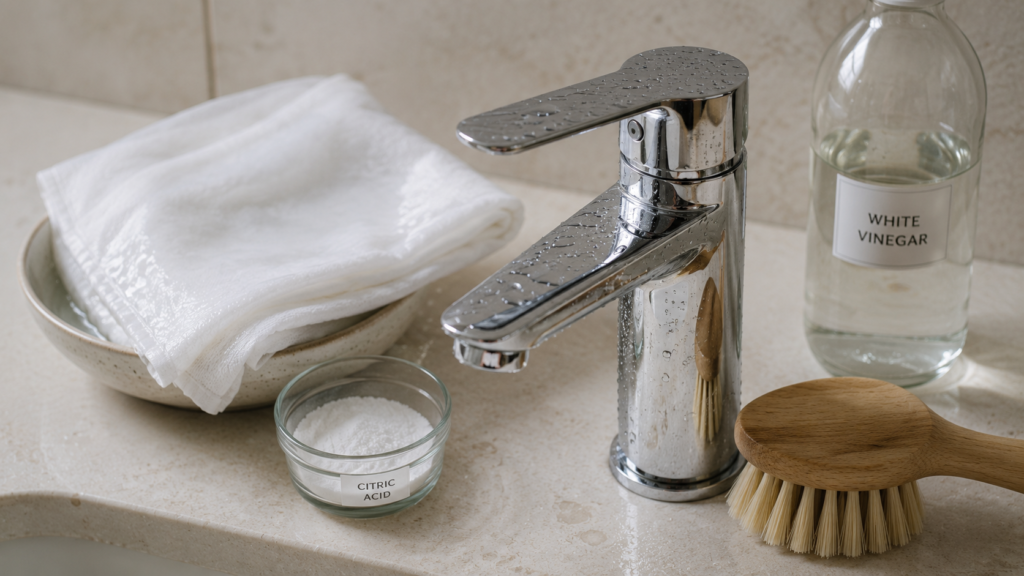
Limescale is alkaline, so you need an acid to dissolve it. White vinegar at full strength is effective for most UK hard-water limescale. Citric acid (available cheaply from homebrew shops and online) is stronger and worth using for stubborn build-up.
For taps and fittings:
- Soak a cloth or paper towel in neat white vinegar.
- Wrap it around the tap or limescale-affected surface.
- Leave for 30 minutes to 2 hours depending on severity.
- Wipe and rinse. For stubborn deposits, repeat or use a soft toothbrush.
For shower heads (fully blocked):
- Mix 2 tbsp citric acid with 500ml warm water in a bowl or bag.
- Submerge the shower head (or fill a bag and secure it around the fitting with a rubber band).
- Leave for 1–3 hours, then rinse by running the water.
Does it work? Yes, very well. I have a Victorian-era bathroom with chrome fittings and genuinely hard Midlands water. The vinegar wrap method removed about 80% of visible limescale in 45 minutes. The citric acid soak unblocked a shower head that had been running at half-pressure for months. This is one of the clearest wins for natural cleaning — commercial limescale remover works too, but this costs a fraction of the price.
Soap scum and general bathroom surfaces
You’ll need:
- 300ml white vinegar
- 200ml water
- 1 tsp castile soap
- 10 drops eucalyptus essential oil (optional)
Method:
- Add castile soap to the spray bottle, then vinegar, then water. Add oil if using.
- Spray on tile, bath surround, or shower tray. Leave 5 minutes for soap scum.
- Scrub and rinse. For grout, use a stiff brush.
Caution: Do not use this on natural stone tiles (marble, travertine, limestone) — the acid will etch the surface. Use a pH-neutral castile soap solution only on those.
Toilet cleaner
This is one of the most straightforward natural swaps, and the one where I noticed no difference in effectiveness versus commercial products.
- Pour 150ml neat white vinegar into the toilet bowl.
- Sprinkle 3–4 tbsp bicarbonate of soda on top. Let it fizz.
- Add 10 drops tea tree oil if desired.
- Scrub with a toilet brush and flush.
The fizzing reaction here actually does serve a purpose: it helps lift deposits from the surface of the bowl. Use the vinegar and bicarb sequentially rather than mixed together — the brief fizzing reaction is more useful when it happens in the bowl itself.
Mildew on grout and sealant
I want to be honest here: this is where natural cleaning has its limits. Established black mildew in grout is difficult to shift without bleach. Here is what works naturally on early-stage or surface mildew — and when to accept that a small amount of diluted bleach is the practical choice.
For mild/surface mildew:
- Make a paste of 2 tbsp bicarbonate of soda and a few drops of tea tree oil.
- Apply to the grout, leave for 30 minutes.
- Scrub with an old toothbrush.
- Rinse and dry thoroughly.
For deep-set black mildew, I use a small amount of diluted bleach (1 part bleach to 9 parts water) as a last resort. I don’t think the perfect is worth the enemy of the liveable here. Preventing mildew by improving ventilation is more sustainable than any cleaning product — keep the bathroom window cracked and run the extractor fan for 20 minutes after showering.
Where to buy the ingredients (UK suppliers)
All of these are available without specialist shopping — most can be sourced from UK supermarkets or hardware shops, with one or two better sourced online for value.
- White vinegar (5%): Any supermarket. Tesco and Sainsbury’s own-brand is fine. Buy the 5-litre bottles for economy.
- Bicarbonate of soda: Supermarkets, but much cheaper in 1kg bags from Dri-Pak (widely stocked in hardware shops and online).
- Washing soda: Dri-Pak again — usually found in the cleaning aisle of independent hardware shops, Wilko, or Amazon UK.
- Castile soap: Dr. Bronner’s is the best-known brand and widely available in Holland & Barrett and some Waitrose and Ocado. Faith in Nature’s liquid soap also works. Avoid the scented varieties if you prefer unscented sprays.
- Citric acid: Online (Amazon, Wilko, The Soap Kitchen) in 500g–1kg bags. Cheaper per use than commercial limescale products.
- Reusable spray bottles: IKEA TOMAT bottles are cheap, cheerful, and widely used. Glass amber bottles (from Amazon or Etsy) are more durable and look nicer if that matters to you.
Free Download
Get the Non-Toxic Home Audit Checklist — free
A room-by-room PDF guide for UK households, with red, amber & green ratings for the most common household products. No overwhelm — just practical swaps, at your own pace.
- Kitchen — cookware, food storage, cleaning products
- Bathroom — personal care, razors, toothpaste
- Laundry — detergents, fabric softener, dryer sheets
- Children’s items — wipes, bath toys, bedding
- General home — candles, paint, air quality
No spam, ever. Unsubscribe any time. Your details are kept private.
The honest summary
Natural cleaning recipes work — for most tasks, most of the time. Where they work best is glass (outright superior to commercial products), limescale (equivalent or better, at far lower cost), and general surface cleaning (perfectly adequate). Where they fall short is deep mildew and some types of heavy grease that need serious alkaline or enzymatic cleaners.
I haven’t eliminated every commercial product from my cleaning cupboard. I still keep a small bottle of diluted bleach for serious mould situations, and I use a commercial enzyme cleaner for anything involving, shall we say, biological incidents. But those are now the exception rather than the rule — a cupboard full of sprays has become three bottles and a bag of bicarbonate. That feels like progress.
The most important thing, as always: buy good microfibre cloths. The cleaning product matters less than the cloth you use to apply it.
The Non-Toxic Home Guide: Room-by-Room Swaps for UK Households
About the author
Nikki Piggott writes about sustainable living, rewilding, and slow living at dayatree.com. She’s been testing, gardening, and foraging her way through an eco-friendly renovation in the UK, and believes strongly that good enough is usually better than perfect.